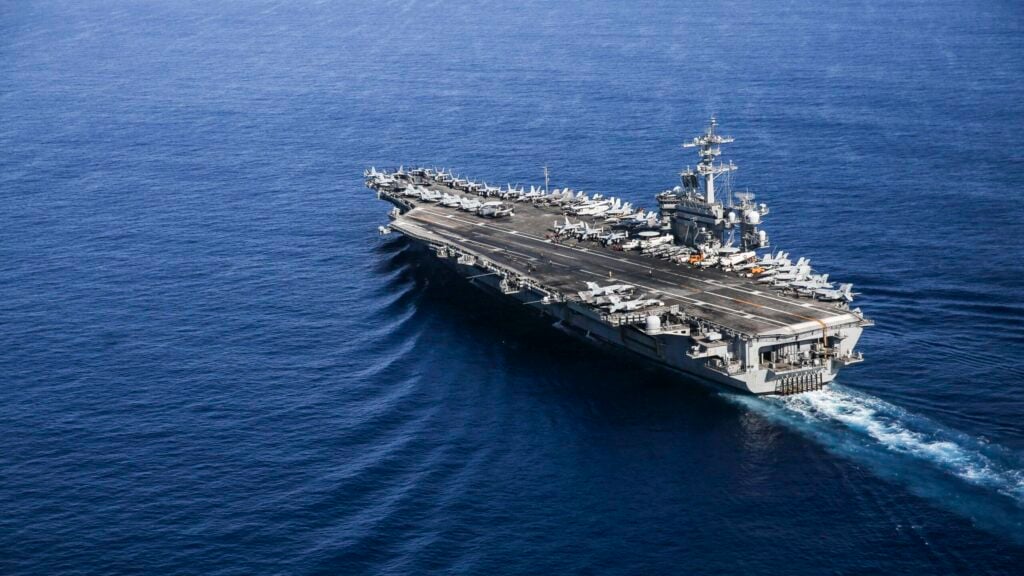
While the carrier strike group will undoubtedly remain the cornerstone of naval power projection, Chief of Naval Operations Adm. Daryl Caudle asserts that the time has come to actively explore alternative options, particularly unmanned systems, for more specialized regional scenarios. This forward-looking approach forms the bedrock of what he refers to as his forthcoming „hedge strategy” for the Navy.
Beyond the Carrier: Adapting to Diverse Global Needs
“If I had a lot of strike groups”—the standardized formation comprising a 100,000-ton carrier, a cruiser, and at least two Aegis destroyers—“I could place these things all over the world,” Caudle stated during his appearance at the Apex Defense conference. “But we don’t have enough, [and] as you think about these various missions around the world—whether it be choke point defense or protection, sea lines of communication, anti-submarine warfare, ISR, maritime domain awareness—I just, quite frankly, don’t need a strike group to do all those.”
Instead, Caudle elaborated, the service should augment its carrier strike groups with smaller, more cost-effective, and highly specialized “tailored forces,” many of which will be unmanned “tailored offsets.” (The term „offset” is a decades-old Pentagon concept referring to new technology employed to counter previously unaddressed challenges).
The Urgency: Limited Assets, Specialized Missions
These „tailored offsets” encompass “capabilities like attritable and easily replenishable USVs [unmanned surface vessels]; MUSVs [Medium Unmanned Surface Vessels] designed for scouting, screening and striking; UUVs [Unmanned Underwater Vessels] for area and water-space denial are [or] countering mines; and low-cost high volume interceptors for counter-drone defense,” he explained. “Together, these tailored capabilities will amplify and complement the main battle force.”
Learning from Submariners: Flexible, Tailored Forces
Consequently, the surface Navy must draw lessons from its submariner contingent—a background Caudle himself shares—and embrace a more flexible “hedge strategy.” This strategy involves assembling smaller “tailored forces,” specifically trained and organized as needed for missions that do not necessitate a full strike group. A significant component of these “tailored forces” will, in turn, consist of “tailored offsets” comprised of specialized, low-cost unmanned surface vessels, mini-submarines, and drones.
From Chokepoints to Contested Waters: Specialized Solutions for Specific Threats
As Caudle detailed, these specific capabilities could span from clearing mines from a “maritime chokepoint” (such as the Strait of Hormuz) to preventing submarines from breaking out past Greenland into the North Atlantic, or providing “supporting fires” in defense of Taiwan.
“We want to remain very flexible, plug and play,” Caudle affirmed. “The challenge historically with the Navy is, I mean, we’re 250 years old, we’re quite parochial.”
Navigating Tradition: Overcoming the „Conveyor Belt” Mentality
This ingrained traditionalism currently manifests as “this mindset that what we do is create these very large strike groups,” the CNO continued. “We love this conveyor belt of the strike group generation process.”
The flip side of the surface fleet’s focus on a regular cycle of standardized training for a fixed carrier strike group formation, he argued, has been an aversion to “tailored” training programs for small, ad-hoc forces—a deployment model more akin to that of the submarine force.
“Submariners, we do not share that vision,” Caudle asserted. “Now there’s a submariner, you know, at the helm here. I’m trying to enlighten people that we can do this safely, effectively and in conjunction with the conversation with the gaining commander”—typically, the four-star theater Combatant Commander—“by giving them more options than the standardized carrier strike group.”
Crucially, securing buy-in from these theater commanders and the Joint Staff will be paramount to the reform’s success, Caudle underscored.
“Combat commanders have to know how to ask for this,” he emphasized. “So it’s got to be packaged in ways that they’re familiar with, they’re comfortable with, it delivers, and then at the end of the day, I can actually convince the Joint Staff and the [Secretary of Defense] that that’s a sufficient thing to do what the combatant commander needs.”
The Unmanned Imperative: Securing Buy-in and Sustaining the Future Fleet
Equally vital will be adapting the Navy’s supporting organizations to effectively train, maintain, and supply the new tailored forces, especially their unmanned components.
“What does that look like in the future?” Caudle mused aloud. “A fleet commander, a resource sponsor and an acquisition team—that’s the standard model.” However, unmanned assets, by their very nature, lack an onboard crew for routine maintenance, suggesting a need for a fundamentally different operational model. The CNO noted that the service is still establishing new unmanned-systems squadrons to address this challenge.
“We’re not currently built that way,” Caudle cautioned. “The challenge with any unmanned [system is], how do I get it to the point of need and sustain it once it’s in that area? Who is responsible when the battery runs out, it tips over, it fails?”