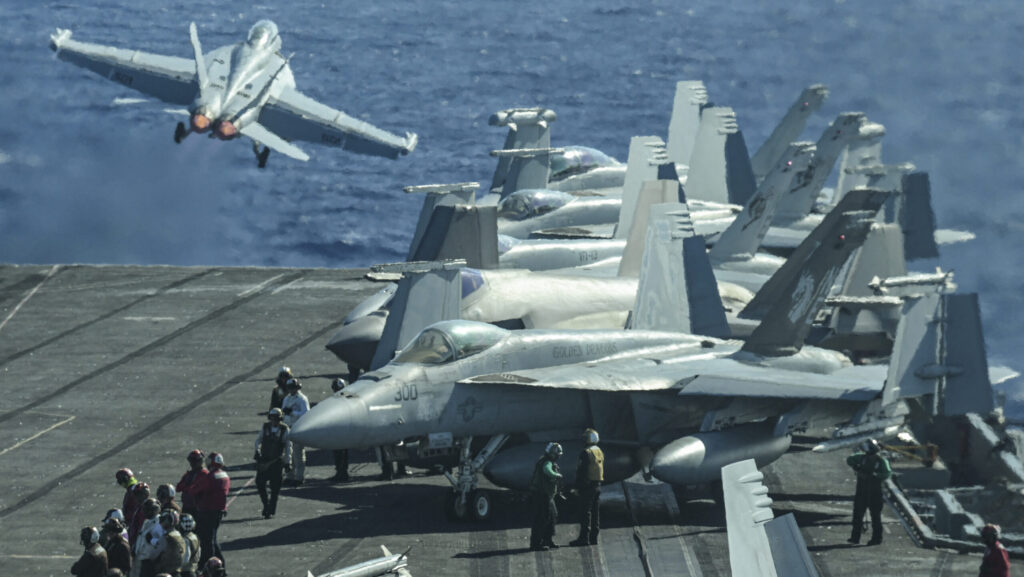
The US Navy has contracted four leading aerospace companies – Anduril, Northrop Grumman, Boeing, and General Atomics – to develop „conceptual designs” for an autonomous combat drone capable of operating from aircraft carriers, according to a Navy document obtained by Breaking Defense.
Lockheed Martin to Oversee Common Control
Lockheed Martin is under contract to develop the drone’s „common control” system. The information comes from a slide on Collaborative Combat Aircraft (CCA) from the Navy’s program executive office for unmanned aviation and strike weapons, dated August 20.
Navy’s „Loyal Wingman” Takes Flight
The contract awards, previously undisclosed, signal a significant step forward in the Navy’s concept of a „loyal wingman” aircraft that can operate from carriers. While the Air Force has publicly emphasized its CCA program, the Navy’s efforts have been largely secretive.
Program Details Emerge
While the exact duration of the contracts and design work remains unclear, a Navy official has verified the accuracy of the document. Both Anduril and Northrop Grumman have confirmed their participation in the program. Lockheed Martin confirmed its role in developing the common control system using its Skunk Works MDCX autonomy platform. General Atomics, while directing specific queries to the Navy, acknowledged rolling out notional designs for carrier-capable CCAs last summer based on the YFQ-42A design being tested under the Air Force’s program. Boeing deferred comment to the Navy.
Unique Navy Requirements
Although the Navy and Air Force share the general concept of CCAs flying alongside fighter jets, the Navy’s program presents unique challenges, including the need for autonomous carrier takeoffs and landings. The Navy is already working on this capability through its MQ-25 unmanned aerial tanker program, designed by Boeing, with carrier flights expected in 2026.
Cost-Effective Approach
The Navy may be pursuing a significantly lower price point than the Air Force, aiming for around $15 million per plane compared to the Air Force’s estimated $25 million to $30 million. This lower cost would allow the Navy to use CCAs multiple times for surveillance and strike missions before using them as expendable, one-way attack drones.
Drone Development Timeline
Rear Adm. Stephen Tedford, the Navy’s program executive for unmanned systems and weapons, stated in April 2024 that the Navy was in the process of analyzing a CCA program, with initial studies focusing on payloads, sensors, and mission systems, and drone fielding expected in the „second half of this decade.”
Successful Demonstrations
In November, the Navy demonstrated its Unmanned Carrier Aviation Mission Control Station (UMCS) controlling a General Atomics MQ-20 Avenger. The UMCS is based on Lockheed Martin’s MDCX autonomy platform, which was developed by its secretive Skunk Works unit. Naval Air Systems Command stated that the test was „part of an effort to advance technology for future Collaborative Combat Aircraft.”
Air Force CCA Progress
The Air Force previously selected General Atomics and Anduril to build and flight test prototype drones. General Atomics’ CCA variant, the YFQ-42A, is currently undergoing flight testing, while Anduril’s YFQ-44A is expected to enter flight testing soon. The Air Force envisions fielding as many as 1,000 drones and plans to hold multiple iterations of the CCA competition.