
















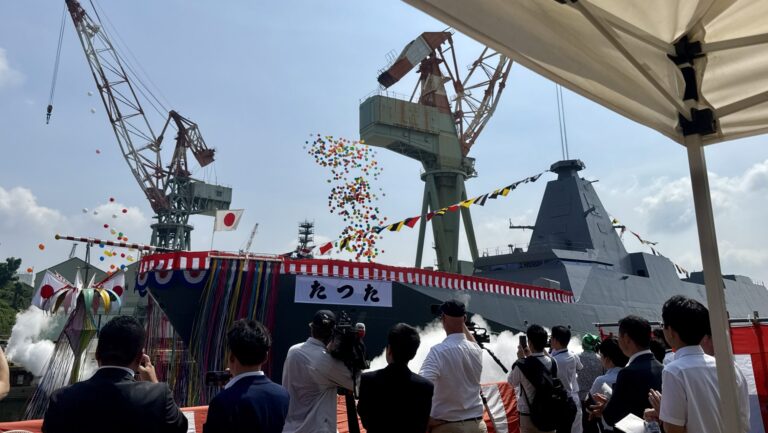
An alternative to building warships overseas
William Toti, nominated to become undersecretary of the Navy, argues that the quickest way to increase the number of U.S. frigates is not to build them in overseas yards, but to bring in a foreign shipbuilder to invest in a new shipyard on American soil.
At his nomination hearing before the Senate Armed Services Committee, Toti said the Navy needs a full range of options to expand its shipbuilding capacity. Destroyers, he noted, are currently carrying out some missions that would ordinarily fall to frigates. A U.S.-based yard dedicated to building those vessels could help address the shortfall more quickly.
Toti said he supports using foreign shipyards to build auxiliary vessels, but not surface combatants. For frigates and other warships, his proposal is to bring foreign shipbuilders’ investment and expertise to the United States, keeping production and jobs in the country.
Foreign shipbuilding becomes a point of contention in Congress
The proposal comes amid disagreement between the Trump administration and Congress. The administration wants to allow a limited number of U.S. Navy vessels to be built overseas, while lawmakers are seeking to restrict that option.
At the hearing, Sen. Angus King noted that Toti’s idea—a U.S.-based shipyard backed by foreign investment—is different from building ships abroad. Debate over the shipbuilding policy is expected to continue.
President Donald Trump has backed expanding the so-called “Finland model,” currently used for the Coast Guard’s Arctic Security Cutters. Under that approach, the first vessels are built in Finland and later ships are built in the United States. A memorandum signed in August says foreign builders could initially construct as many as two ships in their home yards for each of three classes, provided they meet strict conditions for moving future work to the U.S.
The administration has also asked Congress to authorize the Navy to commission foreign yards to build two surface combatants and two non-combat auxiliary vessels under the fiscal 2027 defense authorization bill.
The legislation draws limits but leaves room for auxiliary ships
The House-passed version of the bill, approved in July, bars foreign-yard construction of both warships and vessels in the combat logistics fleet. The Senate Armed Services Committee’s version, approved in June, also restricts overseas construction of warships.
However, the Senate measure would allow the purchase of up to two auxiliary vessels from foreign yards, provided the companies involved invest in the U.S. maritime industrial base and support future ship production in the United States. The final version of the fiscal 2027 bill has not yet been passed.
Separately, the Navy’s budget request includes $1.85 billion in reconciliation funding to study whether U.S. warships could be built in foreign yards. The funding could also help pay for an initial vessel built in Japan or South Korea.
Navy warns of capacity and workforce constraints
Acting Navy Secretary Hung Cao said in May that the United States wants foreign shipbuilders to invest in the American industrial base. He pointed to South Korea’s Hanwha, which acquired a shipyard in Philadelphia in 2024.
Chief of Naval Operations Adm. Daryl Caudle said the options would receive close scrutiny. The Navy needs ships and production capacity, he warned, but the U.S. industry faces workforce constraints and cannot meet demand on its own without approaches such as modular construction and new building techniques.
Toti previously served as a senior adviser to Deputy Secretary of Defense Steven Feinberg. The Navy announced in May that Toti had begun performing the duties of its second-ranking civilian official, and his nomination for undersecretary was formally sent to the Senate in September.