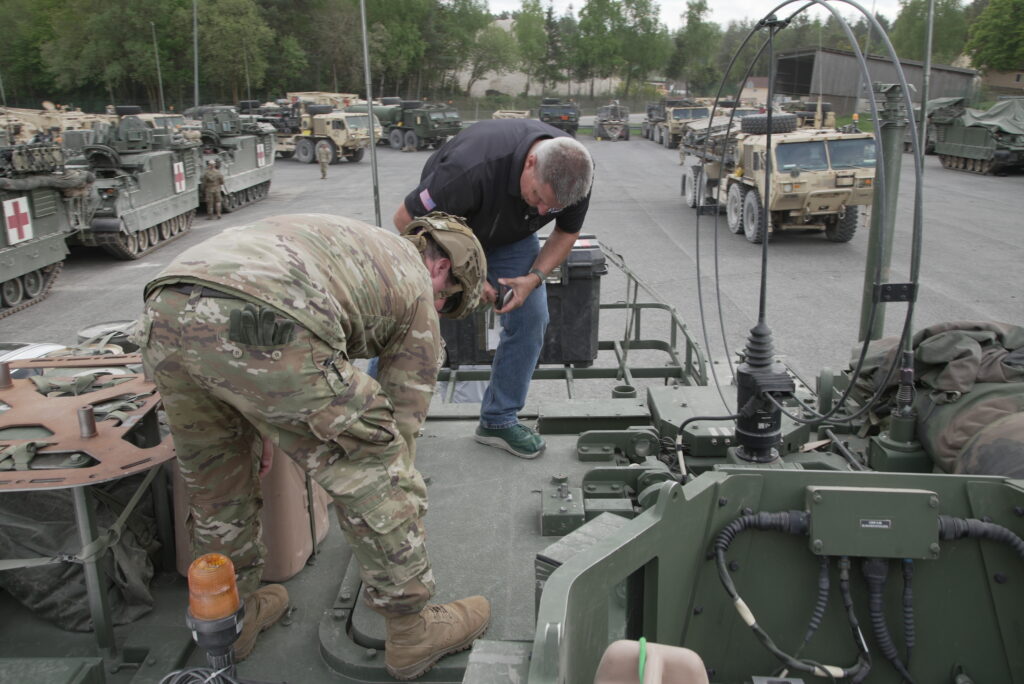
The Army’s Next Generation Command and Control (NGC2) initiative seeks to enhance data transport and analytics while expanding network connectivity to higher echelons and supporting emerging requirements like robotics and sensor integration.
Addressing Data Integration Challenges
Historically, Army mission command systems were function-specific, lacking intuitive integration and data sharing across staff functions or with coalition partners. This made data aggregation challenging, hindering teammates from receiving the right data and permissions for their missions. According to the Army, NGC2 will provide capabilities to deliver large, rich mission command and data packages across all echelons.
Prioritizing Network Transport
Thales Defense & Security, Inc. (TDSI) emphasizes the importance of the network transport layer for enabling the right data to reach the right location. The network should build upon existing infrastructure like secure waveforms, resilient satellite connectivity, and advanced network management tools, while also incorporating new, simpler capabilities.
Hybrid Architecture for NGC2
The network transport layer should leverage a hybrid architecture combining tactical radios, 5G, WiFi, and multi-orbit satellites, TDSI argues.
Gary Kidwell, vice president of communications systems at TDSI, stated, „Army leaders have recognized over the last few years that 5G capabilities and WiFi are tools in the toolbox.” He added that no single technology is the „be-all end-all,” and 5G has its place in the architecture, just like WiFi.
Unified Network for Multi-Domain Operations
Leveraging commercial communication options alongside secure, resilient systems will give commanders multiple communication options to share information with coalition forces in various environments. This unified network will support multi-domain operations, enabling shooters to access sensors that may not be directly on their network and receive real-time battle-damage assessments.
Agnostic Communications and Gateways
Key to solving NGC2 data transport challenges are agnostic communications solutions and gateways that link new and legacy communications systems. Network kits should allow users to plug-and-play any network communications system, from current radios to coalition radios, commercial radio, and SATCOM.
Soldier Touch Points Emphasize Resilient Comms
Transformation In Contact (TIC) unit feedback and Soldier Touch Points have highlighted the need for compute/store and resilient communications capabilities in small form factors. Communication kits should be force multipliers, providing cross-domain and gateway capabilities for formations to choose the appropriate communication pathway for the operational environment.
TDSI’s EDGE Kits
TDSI’s expeditionary EDGE and EDGE-Lite command post kits are designed with these principles in mind. Already provided to some US Army and Special Operations forces, the EDGE family of kits provides PACE communications network management tools and network resiliency by cross-banding military and commercial capabilities like 5G/LTE, while providing a plug-and-play baseband for various SATCOM terminals. The full EDGE variant accepts up to three tactical radios of any vendor model for maximum interoperability.
Local Store and Compute Capability
TDSI continues to refine its kits based on user feedback, such as giving commanders a local store and compute capability at the edge and in EW-disrupted environments when they can’t reach back to the cloud, plus network management software for ease of use.
Combined Resolve Testing
EDGE was recently tested with the 3rd Infantry Division during Combined Resolve 25-2 in Germany. EDGE and EDGE-Lite kits were used at the brigade main command post and at certain battalion levels to maintain network connectivity and command/control on-the-move.
Leveraging LEO, MEO, and Cloud
The Army will strongly leverage proliferated Low Earth Orbit (LEO) satellite comms technologies. EDGE provides organic connectivity to both Iridium Mission Link and Starshield constellations. Satellite terminals and electronically steered array (ESA) terminals will provide on-the-move multiband and multi-orbit connectivity.
Cloud Capabilities for NGC2
Cloud capabilities are also central to NGC2, and each EDGE configuration includes the necessary compute to enable cloud services. EDGE’s compute and transport capabilities enable connection to cloud services in an NGC2 environment by supporting latency-sensitive services and providing access to various services according to mission needs. AI and ML models require compute capabilities for data collection, training, and processing, which TDSI offers as part of its EDGE configuration.
As the Army’s NGC2 program continues to solidify, the agnostic transport network made possible by TDSI’s EDGE kits can efficiently and cost-effectively enable the vital transport function needed.