Amidst escalating tensions and a war of words between President Donald Trump and Colombian President Gustavo Petro, the US President has made a stark declaration: „as of today,” all US government payments to Colombia will cease. While the implementation of this threat remains uncertain, its potential ramifications, particularly for Colombia’s internal security and military capabilities, are significant.
Colombia’s Black Hawk Fleet in Jeopardy?
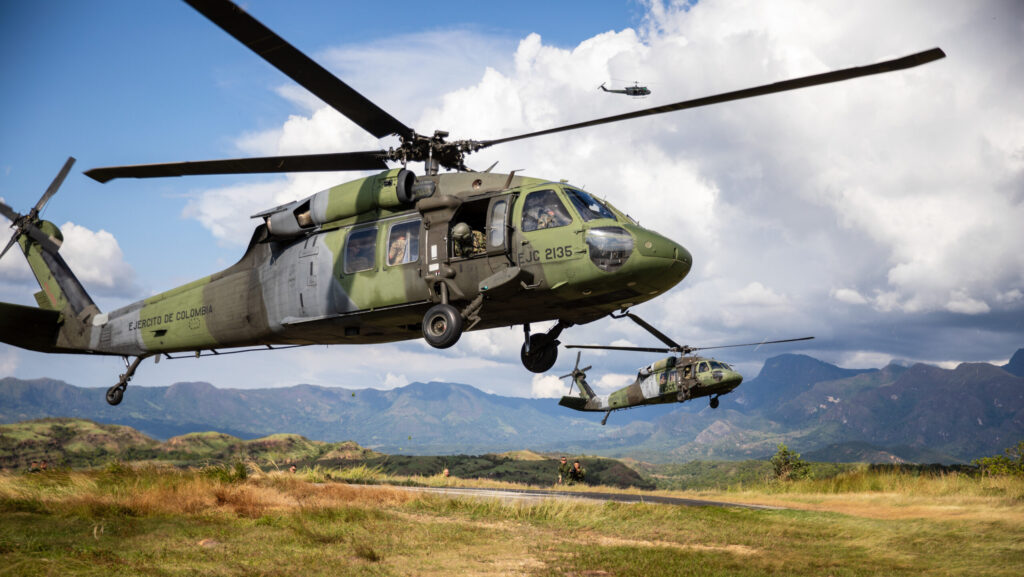
Experts suggest that one of the first sectors to feel the impact of a sudden cessation of US aid could be Colombia’s fleet of Black Hawk helicopters, which are vital to the nation’s fight against narco-terrorists and Marxist insurgents.
Rep. Mario Diaz-Balart, R-Fla., emphasized the critical role these helicopters play in Colombia’s security efforts, stating that they are „vital issues, vital equipment [with] training and maintenance for Colombia” and have „been essential and still are.” He also suggested that salvaging the military-to-military relationship between the two countries is „worthwhile” and „meritorious.”
Elias Yousif, a Stimson Center fellow, echoed this sentiment, stating that a halt in US aid would likely result in an „immediate operational effect” due to Colombia’s dependence on the US for spare parts and maintenance for its Black Hawk fleet.
A Complex Web of US Support
Beyond the immediate impact on the Black Hawk fleet, assessing the broader consequences of a total funding revocation is challenging due to the complicated nature of historical US support for Colombia.
Yousif explained that without granular details on where US funds are allocated, it’s difficult to determine the exact impact of a suspension, as it’s unclear whether funds are earmarked for sustainment, support operations, training, or helicopter maintenance.
Bogota-Washington Relations at a Breaking Point
Colombia has been a security partner to the US for decades, playing a key role in the counter-drug war of the 1990s. In 2022, the country was designated a major non-NATO ally to the US.
However, tensions have been on the rise since Trump returned to office, particularly after Petro alleged that a recent US strike killed a Colombian fisherman with no ties to drug trafficking. Trump retaliated, calling Petro „an illegal drug leader” and vowing to immediately halt all US payments to Colombia.
Embassy of Colombia Statement
Despite the escalating tensions, a representative for the Embassy of Colombia stated that the two countries are continuing to have a „frank and constructive discussion.”
The Embassy’s statement noted that „both sides agreed to continue dialogue in a spirit of cooperation and mutual respect” and reaffirmed their „shared commitment towards efforts against illicit drug trafficking, grounded in accuracy, coordination, and security.”
The Stakes: Military Ties and Funding Transparency
While diplomatic ties are strained, Diaz-Balart believes the military-to-military relationship remains „pretty good,” emphasizing the importance of maintaining this positive relationship despite President Petro’s „erratic and irresponsible decisions.”
However, if the Trump administration suspends all aid to Colombia, the lack of transparency surrounding US funding allocations may make it difficult to pinpoint the exact impact of the decision.
US Aid Figures and Potential Impacts
According to a 2025 Congressional Research Service report, the US provided Colombia with $377 million in foreign assistance in fiscal 2024, including $37 million in Foreign Military Financing (FMF), which must be used on American-made weapons and training.
It’s unclear whether Trump’s threat would include cancelling any potential Foreign Military Sales (FMS) deals in the works, but a State Department fact sheet indicates that the US had approximately $71.6 million in active FMS cases to Colombia as of January 20.
Additionally, the DoD and State Department reported spending $16.6 million in FY22 and $13.3 million in FY23 on training for Colombian military and police personnel.
Michael O’Hanlon, Brooking’s director of Research for Foreign Policy, and Elias Yousif also asserted that the lack of transparency around what security assistance in general, including to Colombia, looks like is becoming “really difficult” to track.
US Military Presence Bolstered in the Western Hemisphere
Amidst the uncertainty surrounding US aid to Colombia, the Trump administration appears committed to maintaining its presence in the Western Hemisphere. The Pentagon recently announced that the Gerald R. Ford Carrier Strike Group is being deployed to SOUTHCOM’s area of responsibility to „bolster U.S. capacity to detect, monitor, and disrupt illicit actors and activities that compromise the safety and prosperity of the United States homeland and our security in the Western Hemisphere.”