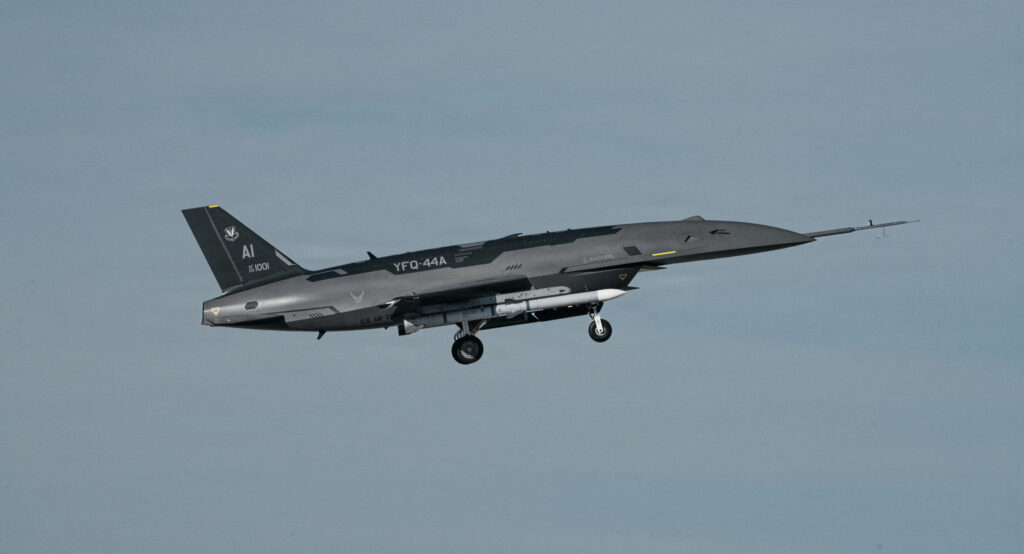
Leaders from the US Air Force and defense industry giants have confirmed significant progress in developing „drone wingmen” for future conflicts, announcing a pivotal development: the first flight tests with live armament underwing. This evolution marks a decisive step towards a new form of aerial warfare.
The Combat Robot Revolution: CCA Program Gathers Momentum
General Kenneth Wilsbach, Chief of Staff of the Air Force, stated that Collaborative Combat Aircraft (CCA), also known as „robot wingmen,” are „progressing rapidly” through their development phase. „The development teams are moving much faster than a traditional program,” Wilsbach emphasized, pointing to an agile and innovative approach.
The YFQ-44A Pioneer: First Flights with Inert Missile
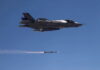
A major revelation came with the announcement that an Anduril-developed drone, designated YFQ-44A, has begun flight experiments carrying a munition. This „captive carry testing” involved, in this case, an inert AIM-120 AMRAAM missile, a crucial step in weapons integration.
„This milestone represents a deliberate step forward in integrating CCA into the Air Force’s future force design,” officials explained. The tests validate the aircraft’s ability to safely carry external stores, confirm structural integrity and aerodynamic performance, and ensure compatibility between the aircraft and its weapons systems prior to any live employment considerations.
Pilot Retains Final Say: Human Control Remains a Key Priority
Even as drones will carry armament, the Air Force stressed that throughout the entire development and testing process, „humans retain authority over weapons release decisions.” The CCA system is designed to operate within established command structures and legal frameworks governing all Air Force weapons systems, ensuring ethical and operational oversight.
Anduril Looks to the Future: From Tests to Real Operations
Jason Levin, an executive at Anduril, confirmed that the company has already started weapons integration on the drone, also known as Fury, and that a live shot is planned for this year. Additionally, Anduril will collaborate with the Air Force to develop tactics for the YFQ-44A, conduct autonomous flights with multiple drones as well as in tandem with crewed fighter jets, and operate outside of test locations for the first time.
„In close partnership with the U.S. Air Force, we have begun a planned series of flight tests with YFQ-44A involving the captive carriage of inert training munitions. This marks a deliberate, responsible, and necessary step in the aircraft’s development,” Anduril stated.
Intense Competition: Other Players on the Combat Drone Stage
The weapons integration announcement did not explicitly mention the other drone prototype under development, the YFQ-42A, manufactured by General Atomics, which was the first of the two to take flight. However, an Air Force spokesperson clarified that both Anduril’s and General Atomics’ bids „are proceeding with their planned weapons integration testing.” While the YFQ-44A has already entered the captive-carry flight phase, the YFQ-42A is expected to begin the same phase „in the very near future.”
General Atomics spokesperson C. Mark Brinkley reiterated the company’s expertise: „We have been integrating weapons for decades. We’ve fired air-to-ground missiles, air-to-air missiles, bombs of various sizes, loitering munitions, and air-launched effects. Weapons from the wings and weapons from the internal bay. No one wonders if we can put steel on target. General Atomics is the most lethal uncrewed aircraft company in the world. That’s not changing.”
General Atomics took the opportunity to name its YFQ-42A „Dark Merlin.” In turn, Northrop Grumman, whose Talon drone (YFQ-48A) was described as a „strong contender in the CCA program,” named it „Talon Blue,” integrating it into a „portfolio of modular, cost-effective, and rapidly deployable aircraft.”
Kratos: From Manufacturer to Strategic Drone Supplier
Meanwhile, mid-sized defense firm Kratos is redefining itself as a „merchant supplier” of drones for industry giants or companies specializing in mission systems. CEO Eric DeMarco explained this strategy: „We are kind of sort of turning into the merchant supplier of tactical jet drones because we’re the only guy that has anything flying right now.”
DeMarco mentioned that Kratos drones have been flying since 2015 (the Mako model), and the company’s expertise attracts partnerships. An example is the Marine Corps’ MUX TACAIR program, won by a Northrop Grumman-Kratos team, proposing Kratos’s XQ-58 Valkyrie combined with Northrop’s Prism open architecture software.
„Northrop Grumman has certain fantastic mission systems, and they have been working on and investing in these specifically related to the Valkyrie for a very, very long time, and they expect to continue to do that,” DeMarco stated, emphasizing that the probability of winning is much higher with a strong partnership.