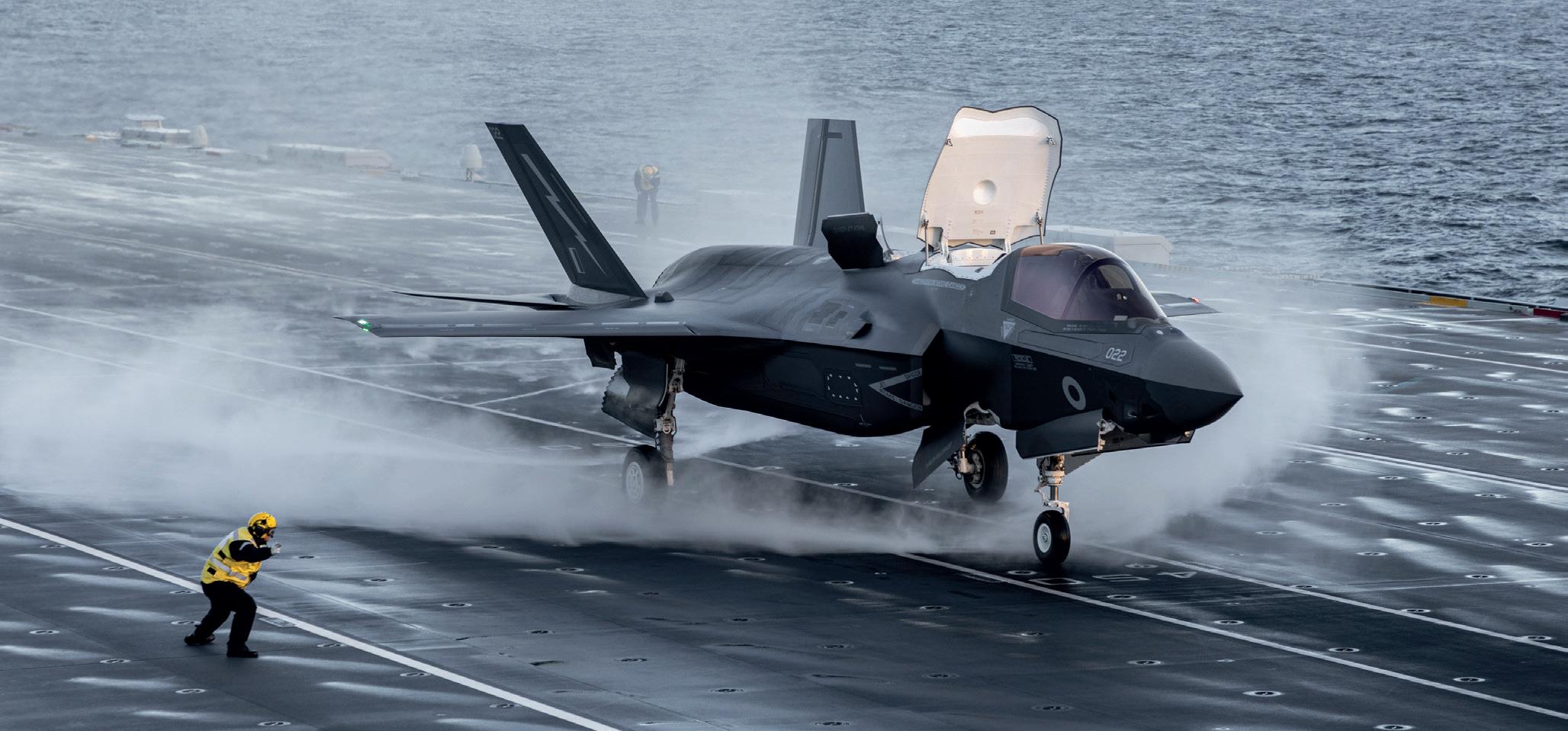
Aerospace titan Lockheed Martin has successfully flight-tested a major innovation for its F-35 Lightning fighter: an artificial intelligence feature designed to identify unknown contacts for the pilot. This demonstration marks a significant step in the evolution of modern air combat capabilities.
A Major Leap in Tactical Intelligence: First Combat ID AI Takes Flight
The company confirmed that this is the first time a tactical AI model has been used in flight to generate an independent „Combat ID” on the pilot’s display. This achievement underscores the potential of artificial intelligence to transform how pilots interact with complex operational environments.
While details on how the AI works were sparse, during a test at Nellis Air Force Base in Nevada, a Lockheed Martin-built and trained AI/machine learning model successfully resolved ID ambiguities among „emitters.” This led to improved situational awareness and reduced pilot decision-making latency. In a military context, „emitters” typically refers to radio-frequency emissions from communications systems and radars, as opposed to infrared or optical sensing.
„Project Overwatch”: AI Enhances Pilot’s Battlefield Vision
The AI identification algorithm proved compact enough to run directly on the F-35’s onboard computers. Furthermore, Lockheed Martin engineers utilized an automated tool to label new emitters, retrain the AI model to learn the new emitter class within minutes, and reload the updated model for the next flight, all within the same mission planning cycle. This flexibility and speed in adapting to new threats represent a crucial strategic advantage.
The system, dubbed „Project Overwatch,” was developed by Lockheed Martin on its own initiative using Internal Research And Development (IRAD) funding, rather than for a specific Air Force contract. This approach demonstrates a proactive vision in integrating cutting-edge technologies.
Decoding the Unknown: A Critical Military Imperative
The F-35, a stealth fighter designed to engage adversaries from much farther away than the human eye can see, relies critically on software to turn complex sensor readings into easily identifiable icons. The more sophisticated the software, the more quickly and clearly it can present information to the pilot, allowing them to focus on utilizing the information to survive instead of deciphering confusing data.
Identifying unknown emitters in this way is a major preoccupation for modern militaries: a novel radio-frequency transmission can indicate anything from an entirely new threat to a well-known radar switching to a different mode. The US Air Force operates a global system to collect data on such emissions, transmit it back to analysts at the 350th Spectrum Warfare Wing, headquartered at Eglin Air Force Base, Florida, and then send updated „Mission Data Files” to aircraft around the world. For older aircraft not designed with modern software in mind, this process can take months. However, for an ever-growing number of systems, the 350th can expedite this process to just hours.
Lockheed Martin aims to position this AI as a significant upgrade to the existing system.
Bridging Generations: 6th Gen Tech on a 5th Gen Platform
Jake Wertz, Lockheed Martin’s VP for F-35 combat systems, stated that this is a „demonstration of 6th Gen technology brought to a 5th Gen platform.” This assertion underscores that „Project Overwatch” provides the F-35, considered a fifth-generation platform, with at least some capabilities equivalent to the upcoming next-generation F-47 aircraft, being built by rival Boeing. Thus, the F-35 strengthens its position at the forefront of military technology, anticipating future challenges.