Tallinn, Estonia — While a recent $6.6 million contract signed by Estonian drone-maker Threod Systems with the United Kingdom for drone launchers might appear modest by international arms deal standards, its quiet price tag belies a far broader and more striking trend: the phenomenal rise of Estonia’s defense industry. The sector has witnessed a spectacular nearly 350 percent growth since 2021, transforming a small Baltic nation into a crucial strategic player on the global defense stage.
An Unprecedented Economic and Strategic Leap
According to a new industry forecast, Estonia’s 138 defense companies are projected to achieve $842 million in sales revenue and an export turnover of $518 million for 2025. These figures would represent a 45 percent increase in sales and a 43 percent increase in export turnover compared to the previous year, demonstrating remarkable acceleration.
The Ukraine War Echo: A Key Growth Catalyst
This explosive growth is inextricably linked to Russia’s invasion of Ukraine. Kyiv has emerged as a valued customer, and persistent concerns that Moscow could attempt a similar move along NATO’s eastern frontier have spurred modernization efforts. Estonian firms have been prompted to move more quickly to address changing threats on the battlefield. One researcher noted that Estonia can adapt its own capabilities to this new warfare quicker than other EU member states due to its geographical closeness to Russia.
Estonia’s Unwavering Commitment: Record Budgets and EU Initiatives
The Estonian military is, of course, a primary customer for local firms. Notably, Tallinn already far exceeds NATO’s 3.5 percent target for core defense spending. Since January, 5 percent of the country’s GDP has been allocated to „core military capabilities,” a fundamental decision, as a senior Ministry of Defense official stressed, that „is not the place you can economize or optimize your spendings.” Estonia’s military expenditure reached approximately $1.5 billion in 2024, marking a 107 percent increase over a decade and a 12.7 percent rise from 2023. Furthermore, Estonia actively supports several key EU initiatives aimed at bolstering eastern defenses, including the Baltic Defense Line, the European Drone Wall, and the Eastern Flank Watch, integrating air defense, surveillance, and electronic warfare.
Drones and Electronic Warfare: Innovation Forged by the Frontline
The ongoing drone warfare in Ukraine has established a clear trend of escalating demand for unmanned vehicles and electronic warfare capabilities. Estonia’s defense industry has built significant expertise and specialization in this area. In addition to Threod Systems, companies such as Frankenburg Technologies (mass-manufacturable anti-drone missiles), DefSec Intel Solutions (AI-powered surveillance and counter-drone systems), Marduk Technologies (passive optical detection systems), and Rantelon (electronic warfare equipment) are actively innovating in drones, counter-drone systems, and related unmanned platforms.
Success Stories: From Launchers to Ground Robots
Threod Systems’ UK contract centers on its Cata launchers, designed to propel drones and loitering munitions into the air. The company, founded in 2012, has grown from 50 to nearly 200 employees, achieving an „1,100 percent increase in sales over five years.” Threod boasts customers in 27 countries, perhaps its most consequential being Ukraine, to which it has supplied 100 to 200 drones. Its Eos C (3rd gen) UAS is used there for reconnaissance and guiding artillery fire, and Threod also trains operators, maintaining a training and service center in Ukraine. The company is now in the final stages of preparing for serial production of its 4th gen UAS (Eos D), which integrates laser target designation for enhanced precision strike capabilities. A company manager suggested a significant role in Ukrainian attacks deep within Russia was played by Cata launchers, capable of launching drones up to 400kg and rapidly deployable.
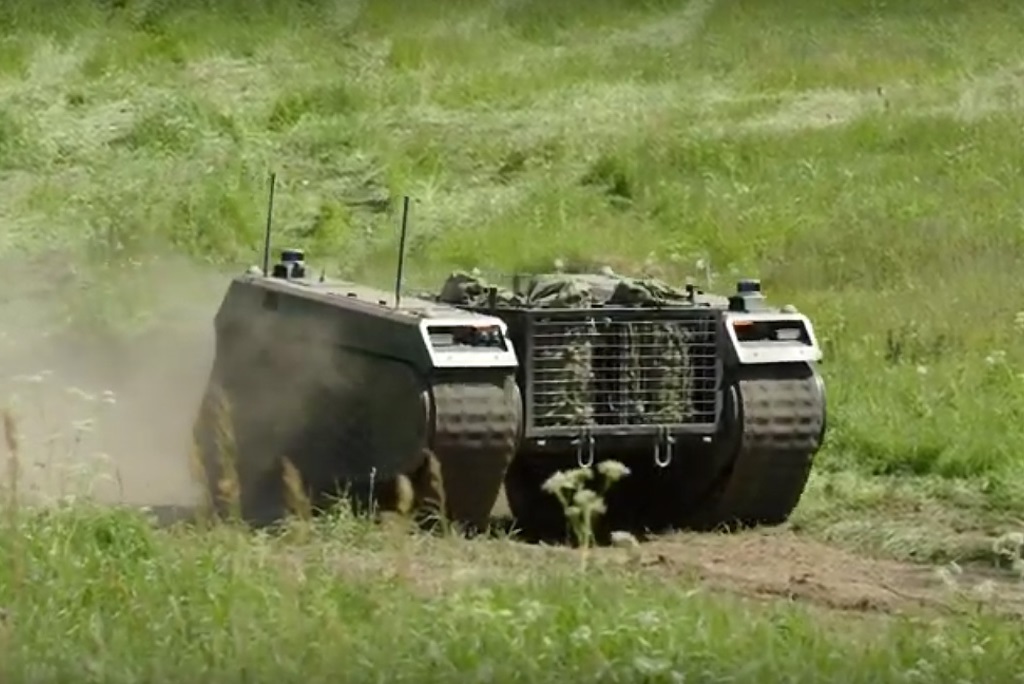
Another Estonian firm whose products have seen action on the Ukrainian battlefield is Milrem Robotics. The company, majority-owned by Emirati defense conglomerate EDGE Group, develops autonomous unmanned ground vehicles (UGVs). Milrem secured an order in October to deliver over 150 THeMIS UGVs to Ukraine, in addition to the 15 already operational there since 2022, as part of a Netherlands-led defense initiative. A company director highlighted that, tragically, the conflict in Ukraine demonstrated the diverse uses of UGVs in combat, especially for frontline logistics where extreme risks to human life make manned transport too dangerous. Initially used for supply deliveries and casualty evacuation, UGVs are rapidly expanding to weaponized systems for direct fire, counter-drone operations, and electronic warfare.
Operation „Spider’s Web”: A Masterclass in Strategic Ingenuity
The value of unmanned systems was never more apparent than during „Operation Spider’s Web,” where Ukrainian intelligence services launched several waves of drones from commercial trucks deep inside Russia to take out Russian military aircraft. A former deputy director general of Estonian intelligence described it as the „brightest moment,” highlighting Ukrainian intelligence’s ability to use „out-of-the-box possibilities” and maintain operational security. Asked about any Estonian role in the strike, the official offered a diplomatic non-committal response, emphasizing the principle of not commenting but praising the innovative spirit of Ukrainians, from whom valuable lessons must be learned.