






The US Air Force plans to award „concept refinement” contracts for the second iteration of its Collaborative Combat Aircraft (CCA) program in early fiscal year 2026, according to an Air Force official.
CCA Program’s Second Round
Col. Timothy Helfrich, director of the Air Force’s Agile Development Office, revealed that over 20 vendors were solicited for the early stage of the drone wingman program’s second round. The service aims to narrow down this pool to a smaller number of vendors, with contracts expected „within the next few months.”
Concept Refinement Phase
Helfrich stated that, similar to the first increment, the second increment will begin with concept refinement, roughly equivalent to the technology maturation and risk reduction phase. This approach allows for a thorough exploration of potential designs and technologies.
Low-End vs. High-End Designs
While initial expectations revolved around more sophisticated, high-end drones, the upcoming increment could potentially focus on cheaper, more expendable systems. Helfrich emphasized that analysis is still ongoing, leaving the possibility of both low-end and high-end designs.
International Partnerships
Brig. Gen. Jason Voorheis, the Air Force’s program executive officer for fighters and advanced aircraft, suggested that international partnerships could influence the service’s requirements for the upcoming increment. „There could be two separate use cases that drive two separate designs that go forward, maybe not for the USAF, but for USAF and a partner,” he explained.
Propulsion RFP
The Air Force recently issued a request for proposals (RFP) on lower thrust range engine solutions. However, Helfrich cautioned against interpreting this as a definitive indicator of the direction of the second CCA increment. He clarified that the RFP targets a segment of the engine market that lacks readily available off-the-shelf options, necessitating targeted investment.
Increment 1 Update
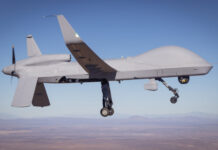
The first CCA increment is currently underway, with General Atomics’s YFQ-42A and Anduril’s YFQ-44A competing for the drone platform contract. A parallel effort is focused on developing the autonomous software for the unmanned wingmen, pairing an autonomy suite developed by RTX with the YFQ-42A and another developed by Shield AI for the YFQ-44A.
Production Decisions
A production decision for Increment 1 is still planned for next year, and the service has „the ability to take multiple vendors into production.” Autonomy development will continue in parallel and is not necessarily tied to a specific increment or airframe.
Flight Tests and Potential Entrants
General Atomics’s YFQ42A completed its first flight last month, while Anduril’s YFQ-44A is expected to take to the skies for the first time in mid-October. Dave Alexander, president of General Atomics’ aeronautics division, suggested that the „Longshot” drone it’s developing under a DARPA contract could be a „great fit” for Increment 2.
Stealth CCA Prototype
Lockheed Martin’s Skunk Works unit unveiled a new stealth CCA prototype known as Vectis, which the company plans to fly by 2027. Skunk Works head OJ Sanchez stated that Vectis could be a „great candidate” if the Air Force requires a highly survivable drone.