As international waters become increasingly contested, naval forces face a dual challenge: the urgent need for ultra-sophisticated detection technology and the harsh reality of logistical limitations at strategic transit chokepoints.
The Undersea Hunt: Technology That „Hears” the Silence
In the Indo-Pacific region, the rules of the undersea game have shifted radically. Russian and Chinese submarines have reached levels of quietness that threaten the decades-long supremacy of Western naval forces. The answer to this threat lies in a new generation of sonobuoys. While appearing to be simple tubes launched from aircraft, these 30-pound devices are hubs of digital innovation, engineered to withstand a 100G impact to become the „ears” of the fleet in the deep.
The primary innovation stems from open-architecture systems, such as „Open Buoy.” This modular approach allows naval forces to integrate new sensors and electronic warfare capabilities in months rather than years, transforming every unit into an adaptable node within a complex surveillance mesh network.
Capacity vs. Reality: The Escort Dilemma in Hormuz
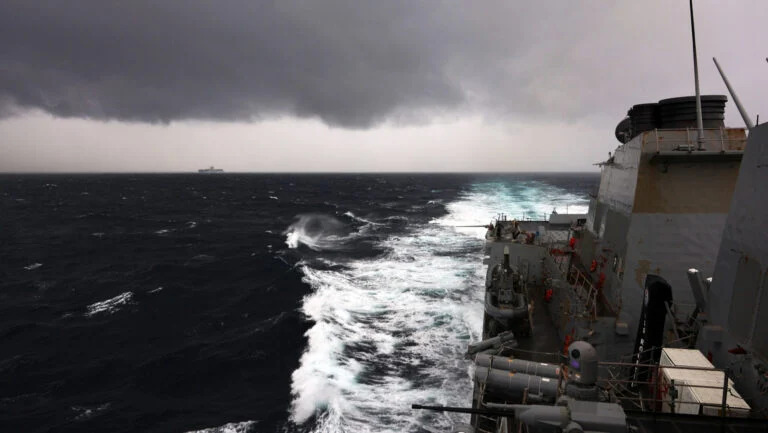
While technology advances beneath the waves, surface logistical limits are forcing difficult strategic choices. Naval leadership recently cautioned that providing escorts for commercial vessels in the Strait of Hormuz exceeds the fleet’s current effective capacity. In a contested and mined environment, such a mission is deemed extremely risky and nearly impossible to execute efficiently without a generally accepted ceasefire.
Although the idea of escorts was circulated at the political level, the reality on the ground shows that resources are currently concentrated on enforcing a blockade of adversary ports. This „squeeze” strategy appears to be yielding results, with over 90 commercial vessels already redirected, thereby forcing progress in diplomatic negotiations.
Pressure Diplomacy and the Future of Maritime Dominance
The success of modern military operations is no longer measured solely by direct victories, but by the ability to bring adversaries to the negotiating table. The maritime blockade is currently viewed as the most effective tool of leverage in negotiations with Tehran. However, the balance remains fragile. Between promises of protecting trade routes and the technical capacity to monitor the „invisible” in the depths, naval forces must navigate an era of digital transformation and strategic caution.