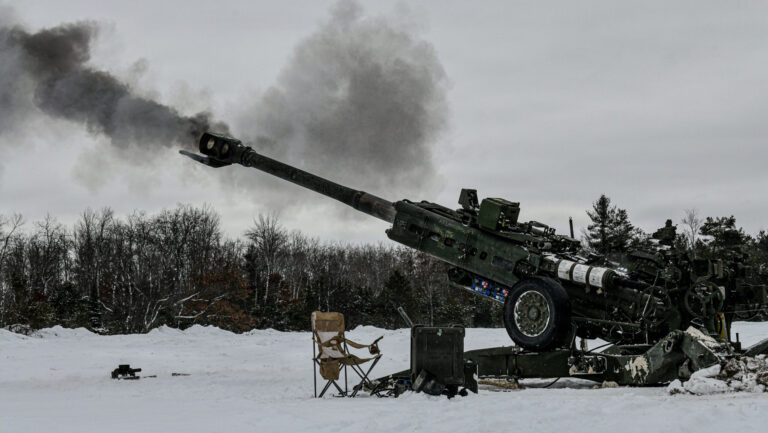
The United States Army has fallen significantly short of its ambitious goal to produce 100,000 155mm artillery rounds per month, according to a new Pentagon watchdog report. The document highlights a resounding failure at a production facility in Mesquite, Texas, which, despite officially opening in 2024, has failed to deliver any usable components to date. This inability to ramp up production threatens the combat readiness of American forces and the capacity to support allies in potential future conflicts.
The 155mm production deadlock: Real figures fall far short of military ambitions
Following Russia’s invasion of Ukraine in 2022, the US Army attempted a rapid industrial mobilization, aiming to increase production from 14,000 to over 100,000 shells monthly by October 2025. The reality on the ground is bleak: as of March, five months after the deadline, production capacity only reached 36,000 units. The major shortfall is due to two out of three existing plants failing to meet their quotas, while the new Texas facility, operated by General Dynamics Ordnance and Tactical Systems (GD-OTS), remained at zero due to unproven production processes and non-compliant equipment.
The Mesquite disaster: Non-compliant equipment and missed milestones in a high-risk venture
The 469 million dollar investment in the Mesquite plant was considered from the start a „high-risk, high-reward” opportunity. Military officials accepted a proposal based on unproven technological processes, banking on the immediate availability of equipment. The result was a series of failures: missed milestones, show-cause letters, and ultimately, stop-work orders. Although GD-OTS recently agreed to invest its own funds to complete the project, the Army has already lowered the production target for this location from 30,000 to 20,000 units per month.
Allied vulnerability: The failure to reach production quotas threatens global security
The problems are not limited to Texas. The Scranton plant in Pennsylvania, also managed by GD-OTS, is operating at less than half its planned capacity due to modernization difficulties. In Canada, the Ingersoll facility is facing similar setbacks. The only glimmer of hope comes from the Wilkes-Barre plant, which is meeting its quota of 21,000 rounds per month. Without a swift resolution to these industrial deficiencies, Washington risks lacking the logistical muscle needed to ensure stability in global hotspots, where the demand for artillery ammunition remains critical.