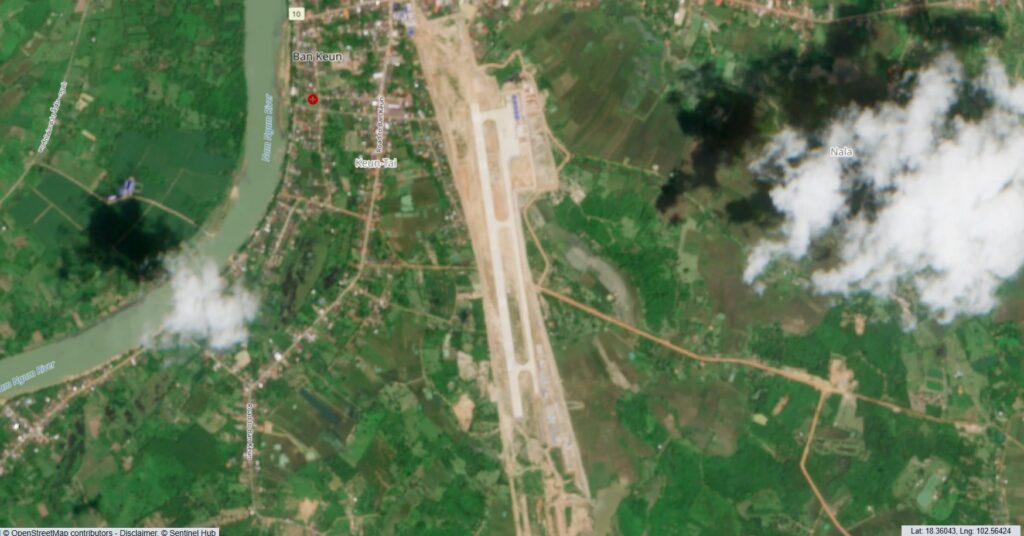
China and Laos have inaugurated a joint support and training center at Ban Keun airfield, approximately 40 kilometers north of Vientiane. Beijing describes the facility as a project focused on military cooperation and the training of Laotian pilots, but its opening represents a broader expansion of China’s military presence in Southeast Asia.
At the same time, the United States is accelerating investments in its defense industry through multibillion-dollar contracts covering missiles, interceptor rocket motors and advanced fighter aircraft.
China Strengthens Its Military Presence in Southeast Asia
The new complex includes two institutions: the China–Laos Joint Support and Training Center and the China–Laos Friendship Aviation Academy. Both facilities will be jointly operated and maintained by the two countries.
According to Chinese authorities, the site will primarily be used to train Laotian pilots and expand practical cooperation between the two militaries. Beijing says the project complies with the domestic laws of both countries, international law and established practices.
China has emphasized that the facility is not directed against any third party and is intended to support peace and stability in the region. However, its location near the Laotian capital and the scale of the aviation infrastructure give the project wider strategic significance.
China’s Third Overseas Military Facility
The Laos facility is now the third known Chinese military installation outside the country. China already operates a military base in Djibouti, which opened in 2017, as well as a naval facility at Ream in Cambodia.
The new center in Laos strengthens Beijing’s position in Southeast Asia, a region central to strategic competition in the Indo-Pacific. Laos, a landlocked country and one of China’s closest regional partners, maintains extensive political, economic and military ties with Beijing.
The presence at the inauguration of Laotian Deputy Prime Minister and Defense Minister Khamlieng Outhakayson underlines the official support provided by Vientiane.
A 2,000-Meter Runway and Five Hangars
Satellite imagery indicates that construction at the site has progressed rapidly. The runway, which was still in the early stages of construction at the beginning of the year, now measures approximately 2,000 meters.
An aircraft parking apron and five hangars have been built at the northern end of the facility. The scale of the infrastructure extends beyond the basic requirements of a flight-training academy and could allow the site to support broader aviation operations.
The airbase appears to have been constructed partly over the location of a former airfield known during the Vietnam War as Lima Site 44. The airfield was part of a network of runways and outposts used by the United States and the Central Intelligence Agency in Laos.
Washington Accelerates Defense-Industrial Expansion
As Beijing develops its overseas military infrastructure, the United States is increasing production capacity for programs considered strategically essential.
The Pentagon awarded Raytheon, a subsidiary of RTX, a contract potentially worth up to $20.7 billion for the production of AIM-120 AMRAAM air-to-air missiles. The seven-year agreement is intended to nearly double output to approximately 1,900 missiles per year.
The goal is to replenish U.S. inventories depleted by weapons transfers supporting Ukraine and by ammunition consumption associated with conflicts in the Middle East.
L3Harris Expands Interceptor Motor Production
L3Harris received a contract valued at more than $6 billion from Lockheed Martin to manufacture solid-fuel rocket motors for THAAD interceptors.
The agreement is designed to increase production capacity roughly fourfold. L3Harris plans to build a new facility capable of supporting both the THAAD program and the demand for motors used by Patriot PAC-3 systems.
The move reflects the growing pressure on the U.S. defense industry to rapidly increase interceptor production and rebuild strategic inventories.
Boeing Wins the Navy’s F/A-XX Program
Boeing has been selected as the prime contractor for the U.S. Navy’s sixth-generation F/A-XX fighter. The full-scale development phase is valued at more than $20 billion.
The aircraft is intended to gradually replace the Navy’s F/A-18 Super Hornets and EA-18G Growler electronic warfare aircraft. The first aircraft are expected to enter service during the 2030s.
Boeing’s selection strengthens the company’s position in advanced U.S. military aviation programs, following its earlier victory in the Air Force’s sixth-generation F-47 fighter competition.
F-15EX: 22 More Aircraft, but Additional Risks
The U.S. Air Force awarded Boeing an approximately $2.4 billion contract for 22 F-15EX aircraft. The new production lot brings the total number of aircraft ordered to 120 out of a planned fleet of 267.
The contract was finalized before the October 1, 2026, deadline for obligating funds approved through the budget reconciliation process. Failure to contract the funds on time could have reduced the amount available for the program.
The F-15EX features an upgraded radar, advanced electronic warfare systems and other improvements intended to extend the platform’s operational life.
Boeing Faces Mounting Execution Pressure
Boeing’s expanding military portfolio has also raised concerns about the company’s ability to manage several major programs at the same time. The company must advance the F/A-XX, F-47, T-7A and F-15EX programs, with much of the work concentrated at its facilities in St. Louis.
The F-15EX program is already facing delays. Full operational capability has been pushed to February 2028, approximately seven months later than previously planned.
Several aircraft systems may also require significant redesigns. Potentially affected components include the radar, engines and electronic warfare suite, as some systems have become obsolete or are facing supply-chain difficulties.
Strategic Competition Is Expanding Across Factories and Airfields
Developments in Laos and the United States illustrate two parallel dimensions of modern military competition: the expansion of strategic infrastructure and the growth of industrial capacity.
China is strengthening its network of overseas facilities, while the United States is investing heavily in the production of missiles, interceptors and fighter aircraft. In both cases, the ultimate outcome will depend not only on the size of the contracts or the scale of the bases, but also on the ability to complete projects on schedule and integrate them into a coherent military strategy.