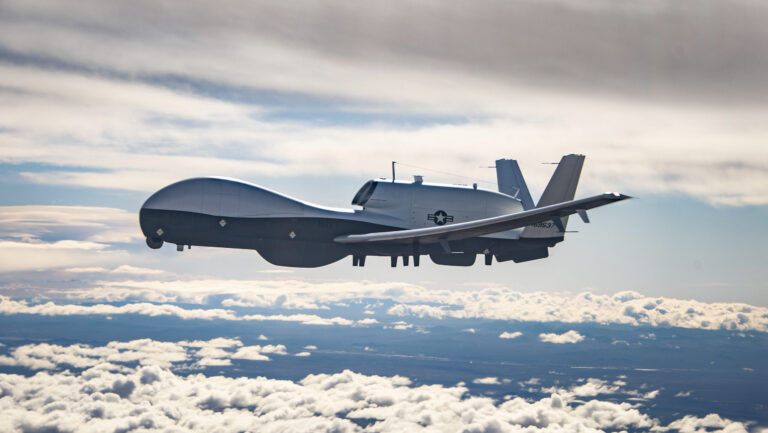
At the recent summit in Turkey, NATO nations marked a turning point in collective defense strategy by announcing the planned purchase of five MQ-4C Triton unmanned aerial vehicles. Led by Denmark, Finland, Germany, and Norway, this initiative aims to expand the Alliance’s ISR Force, bolstering the fleet of RQ-4D drones already operational in Sigonella, Italy. While the news is welcomed with enthusiasm, experts warn that the mission’s success depends on overcoming historic tactical and logistical barriers.
Eyes in the sky: Triton technology unveils the secrets of Russia’s shadow fleet
From a tactical perspective, the integration of Triton systems offers NATO an unprecedented technological edge. Unlike current models that rely solely on synthetic aperture radar, the Triton brings electro-optical, infrared sensors, and signals intelligence (SIGINT) capabilities to the arsenal. This configuration is ideal for monitoring Russia’s „shadow fleet,” consisting of smuggling vessels that attempt to evade detection by spoofing location data or blacking out identification systems. With the new aircraft, electronic camouflage becomes nearly impossible, providing total clarity over suspicious maritime movements.
Beyond American dependence: The Alliance’s strategic autonomy in the Trump era
On a strategic level, the acquisition represents a decisive step toward reducing Europe’s reliance on United States surveillance capabilities. In the context of pressure from the Trump administration for equitable defense burden-sharing, this move demonstrates a political maturation of NATO. By operating its own high-altitude aircraft, the Alliance gains essential flexibility and autonomy, ensuring that critical information is collected and processed internally, rather than waiting for American logistical support that might be delayed in crisis situations.
The invisible obstacles: The personnel crisis and the need for a mixed fleet
Despite the optimism, the project faces the harsh reality of human resources. The history of the Sigonella surveillance force shows chronic understaffing, with the unit operating at only 60% capacity, which drastically reduced flight frequency. Furthermore, experts emphasize that the 10 aircraft (5 RQ-4Ds and 5 Tritons) are not enough to cover Europe’s hotspots, from the Baltic Sea to the Eastern Flank. For a robust defense, NATO must aim for a fleet of at least 15 units, including medium-altitude drones like the MQ-9B, capable of executing missile strikes in the event of open conflict.