The Air Force Research Laboratory (AFRL) is gearing up for flight tests in late 2025 and early 2026 of prototype antennas and radio receivers designed to seamlessly switch among multiple commercial satellite internet constellations. This capability is expected to enhance resistance to jamming and support the Pentagon’s ambitious Joint All Domain Command and Control (JADC2) network.
Under the Global Lightning initiative, AFRL researchers aim to integrate this technology not only into Air Force airborne systems but also into platforms utilized by other branches of the military. According to Brian Beal, principal aerospace engineer at AFRL’s Strategic Development Planning and Experimentation Office, the program is intended to demonstrate versatility across various military applications, including ground vehicles, ships, and stationary systems.
“The end game is, if we’re wildly successful, I would expect different program offices to adopt and field this technology,” Beal noted, highlighting potential collaboration with the Space Force’s Commercial Satellite Communications Office to facilitate contracts with commercial providers.
AFRL is actively partnering with the Space Development Agency (SDA), which is developing its own low Earth orbit (LEO) space-based internet system as part of its Transport Layer program. “One of the guiding principles of what we’re trying to do is create radios capable of interfacing with multiple constellations. These radios will also be able to incorporate new waveforms and control mechanisms as new constellations emerge,” Beal explained.
The Global Lightning program was launched in 2018 under the formal title “Defense Experimentation Using Commercial Space Internet (DEUCSI),” with nearly $500 million allocated to experimental contracts across 11 different vendors. Key contracts have been established with multiband radio manufacturers such as L3Harris, Northrop Grumman SES Space and Defense, and Intelsat General, alongside antenna producers like Northrop Grumman, RTX, and Viasat.
AFRL currently allocates around $160 million annually for the Global Lightning program, though this amount may fluctuate as contracts are added or phased out. Recent contracts established under DEUSCI Call 4 focus on prototypes for multiband antennas that can connect with Ku-band and Ka-band satellites in various orbits, with RTX and Viasat receiving significant awards of $51.7 million and $33 million respectively.
The strategic aim of these antennas is to work in conjunction with modems and transceivers developed during the previous contract phase (DEUCSI Call 3), a solicitation that saw AFRL contract with several key players for around $250 million.
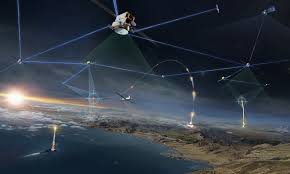
Beal delineated the two stages of the Global Lightning program: the initial phase focused on connections to individual satellite constellations, while the current stage emphasizes “multi-vendor, multi-constellation SATCOM.” This strategy is designed to create hardware capable of communicating with various satellite constellations across different orbital altitudes (LEO, MEO, and GEO) and frequency bands.
The program’s objective is to develop what Pentagon officials refer to as a “hybrid SATCOM” network, which overcomes significant obstacles in integrating new SATCOM systems into aircraft. Beal explained, “One of the biggest barriers to entry has been the installation of hardware, particularly antennas. Our goal is to equip systems that can communicate with multiple constellations, enabling a transition from one constellation to another based on operational needs.”
Upcoming flight tests will begin with establishing reliable connections with specific constellations, gradually increasing in complexity to include stress tests that analyze connectivity during various aircraft maneuvers. This will assess how far an aircraft can bank without losing connection and evaluate transition times between different satellites.
“As we go, our expectation is to bounce between those constellations within the same flight,” Beal emphasized. While he noted that full interoperability might not be guaranteed on the first test flight, he remains optimistic about achieving this goal over time through iterative improvements.