



















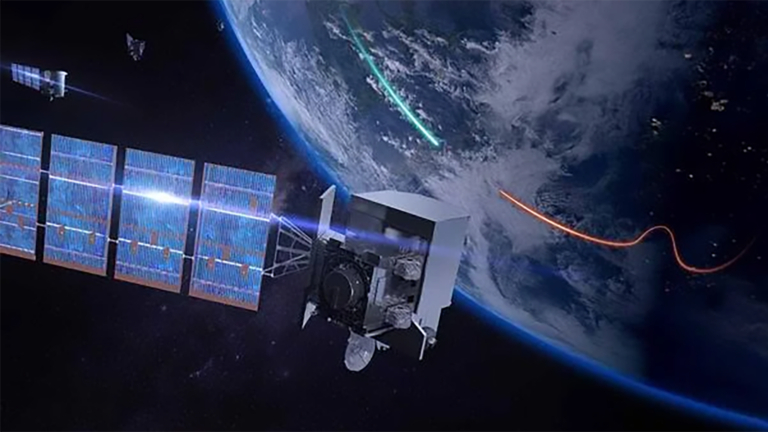
The Pentagon is ramping up its orbital defense capabilities by awarding $1.75 billion in contracts to L3Harris and Sierra Space. The objective: operationalizing a massive satellite network by 2028, aligning with the White House’s strategic timeline.
The Space Development Agency (SDA) has taken a decisive step in fortifying the United States’ defense architecture by signing major agreements to develop 36 next-generation satellites. These „birds” will form the core of the missile warning, tracking, and targeting system, serving as essential pillars of the missile shield known as the „Golden Dome.”
A Race Against Time Under Presidential Mandate
The new space vehicles, part of the „Accelerated Missile Defense Tranche 3” (AMDT3) program, have an extremely ambitious launch deadline: 2028. This acceleration is no coincidence; it directly responds to President Donald Trump’s mandate for the Golden Dome system to be operational by that year.
The expedited schedule is remarkable, considering that other third-generation (Tranche 3) satellites, previously contracted with other aerospace giants, are not slated for launch until 2029. By making this move, the Pentagon is cutting through bureaucratic and technical delays to stay ahead of emerging hypersonic threats.
Surgical Precision: From Detection to Fire Control
The technology to be deployed redefines how global airspace is monitored. L3Harris was awarded a $955 million contract to provide 18 satellites specialized in ballistic and hypersonic missile defense. These sensors are capable of generating „fire control quality” data, providing interceptors with the exact coordinates needed to strike targets with millimeter precision.
Meanwhile, Sierra Space, under a $798 million contract, will contribute 18 warning and tracking satellites. The technological distinction is vital: while some satellites „sweep” vast areas to detect launches using infrared sensors, the specialized defense variants utilize medium field-of-view cameras. These are significantly more precise, capable of tracking the trajectory and velocity of hypersonic objects designed to evade conventional radar.
Massive Investment in Tomorrow’s Innovation
The success of this program is built on years of private research and billions of dollars in investment. Sierra Space has already funneled $1.5 billion of its own capital into scaling its infrastructure and developing revolutionary optical sensors, including 8K focal plane arrays. This high-resolution technology allows for data processing via advanced software, converting a simple tracking image into vital tactical information.
Similarly, L3Harris has refined its initial sensor designs through self-funded technological enhancements, ensuring these new orbital assets can identify not just the presence of a missile, but its precise spatial and temporal trajectory with high confidence. As a result, the „Golden Dome” is evolving from a theoretical concept into an imminent technological reality, poised to protect U.S. territory and allied forces against the world’s most advanced threats.


