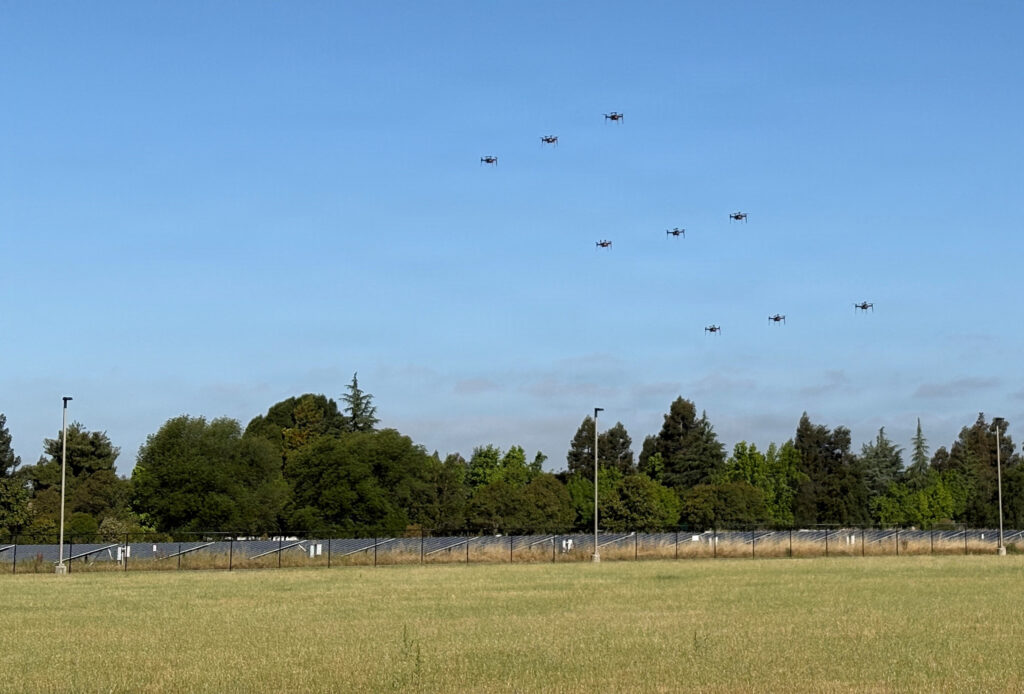
As drones become a permanent fixture on the modern battlefield, the primary challenge for military forces is managing massive fleets without relying on a „one operator per drone” model. Palladyne AI proposes a solution inspired by biology, providing drones with the ability to „think” and collaborate autonomously, even in environments where communications are jammed or GPS signals are unavailable.
Defining the gap between automation and true autonomy on the battlefield
Ben Wolff, President and CEO of Palladyne AI, warns that there is a major confusion in the industry between pre-programmed flight and true autonomy. While automation refers to basic tasks, such as collision avoidance or following fixed waypoints, autonomy involves the drone’s ability to react in real-time to the unpredictable.
„Autonomy means the drone processes what it sees and decides for itself how to prioritize the mission based on predefined parameters, not rigid instructions,” Wolff explains. For example, an autonomous drone can decide on its own to abandon following a vehicle to surveil an individual who stepped out of it, without waiting for an order from the operator. However, critical decisions—especially those involving the use of force—remain under human control, with the technology serving as a force multiplier that frees the soldier from the micro-management of piloting.
Biological inspiration: Applying ant and bee colony logic to edge computing
Unlike most current artificial intelligence systems that depend on „cloud” processing, SwarmOS runs directly on the local processor of each drone. This decentralized approach is inspired by nature, specifically the way ant colonies and beehives collaborate without a command center providing individual instructions to each member.
This architecture eliminates latency and the need for a constant connection to a central server. In the real world of electronic warfare, where data links can be severed at any moment, drones equipped with SwarmOS can communicate with each other via mesh radios, exchanging only essential snippets of information. Thus, the entire swarm functions as a unified organism, capable of identifying targets or threats and transmitting this data collectively.
Expanding the mission: From precision manufacturing to low-cost cruise missiles
Palladyne AI is not limited to developing digital brains for drones. With a three-decade history in research and development, the company—formerly known as Sarcos Robotics or Raytheon’s robotics division—has transformed into a mid-tier defense prime for the Pentagon. They now produce high-value precision components for F-35 and F-22 aircraft and Abrams tanks, aiming to reduce costs and increase the resilience of the American supply chain.
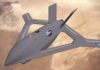
Another major direction is the development of a long-range precision effects platform, designed to cost only a fraction of today’s cruise missiles. Moving from concept to first flight in less than six months, the project has progressed at a pace considered unheard of in the traditional defense industry.
Proven in the field: Coordinating multi-vendor swarms with a single operator
Recently, SwarmOS was put to the test in a large-scale joint military exercise, where it demonstrated that it could coordinate a swarm composed of drones from different manufacturers (OEMs). A single soldier managed multiple aircraft that collaborated to complete a complex mission, exceeding the initial expectations of officials.
The conclusion for the Pentagon is clear: the technology is no longer in the realm of science fiction. SwarmOS offers a scalable, hardware-agnostic solution that allows operators to focus on strategic decisions while the technical „noise” of navigation and coordination is handled by the machines. The challenge now remains the rapid integration of these systems into the active arsenal to maintain a technological edge in a theater of operations increasingly saturated with autonomous systems.