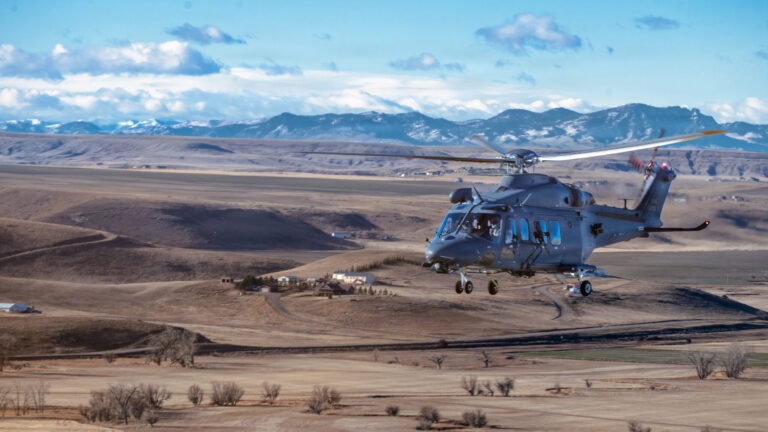
The United States Air Force declared its MH-139A Grey Wolf helicopter operational in early August, marking the beginning of the aircraft’s transition into missions protecting the country’s nuclear missile facilities.
Manufactured by Boeing, the new helicopter is gradually taking over duties performed for decades by the Vietnam-era UH-1N Huey.
Initial units are now able to operate and maintain the aircraft
The Grey Wolf achieved initial operational capability on August 10. The milestone means that selected units have received the helicopter and have the personnel, training and procedures required to operate and maintain it in an operational environment.
The development represents a significant step in the modernization of the helicopter fleet responsible for securing the United States’ nuclear infrastructure.
Certification challenges caused years of delays
The MH-139 program faced several setbacks during development. Difficulties in securing certification from the Federal Aviation Administration contributed to substantial delays, postponing the helicopter’s entry into service by several years.
A 2021 report had indicated that the aircraft could achieve initial operational capability as early as 2023.
Colonel Bryant Bevan, commander of the 582nd Helicopter Group, described the transition to the new platform as a major improvement for the protection of the US nuclear deterrent.
The 582nd Helicopter Group played an important role in the aircraft’s testing and introduction. Its activities included the first operational escort of a convoy carrying Minuteman III intercontinental ballistic missiles, conducted in January.
Greater speed, range and survivability
The Air Force says the MH-139 provides significant advantages over the UH-1N, including:
- higher speed;
- extended range;
- improved defensive systems;
- the ability to carry twice as many troops.
The aircraft is a militarized version of the commercial Leonardo AW139. Its capabilities are intended to support missions protecting missile facilities and securing the Minuteman III weapons system.
Following publication of the report, Boeing said that the helicopter’s achievement of initial operational capability validated years of development and innovation and provided the Air Force with a more modern platform for safeguarding critical national assets.
International interest has not yet led to new contracts
Boeing has previously said that the MH-139 attracted interest from potential international customers. No new foreign contracts for the helicopter have been publicly announced so far.
As additional Grey Wolves are delivered, the UH-1N fleet will gradually be retired. Changes to the program of record have nevertheless altered some of the missions originally envisioned for the MH-139.
HH-60W takes over the VIP transport mission
Although the MH-139 has been associated with missions such as search and rescue, disaster response and medical evacuations, the Air Force no longer expects to use it to transport VIP passengers around the National Capital Region.
That role will instead be assigned to the HH-60W Jolly Green II, the Air Force’s newest combat rescue helicopter, built by Sikorsky, a Lockheed Martin subsidiary.
The 5th Helicopter Squadron was activated at Joint Base Andrews in Maryland to operate the HH-60W for VIP and security missions in the Washington area. Like the MH-139, the Jolly Green II will replace UH-1N helicopters currently performing the mission.
1st Helicopter Squadron will temporarily continue operating the UH-1N
Over the next several years, the 5th Helicopter Squadron will train aircrews and maintainers, establish operational and maintenance procedures and receive the aircraft needed to assume the national security mission in the National Capital Region.
Until the 5th Squadron is fully operational, the 1st Helicopter Squadron will continue flying the UH-1N. The unit will maintain its round-the-clock response mission while preparing personnel and aircraft for the transition to the next generation of Air Force capabilities.