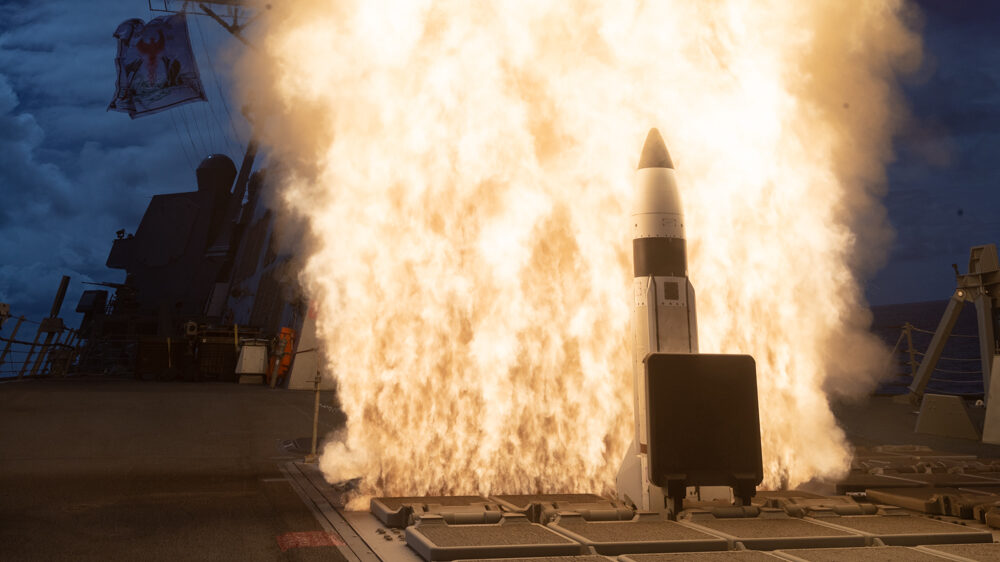
The US military announced a significant advancement today with the successful test intercept of a ballistic missile from its Guam-based missile defense system, marking a “critical milestone” as the country enhances its defense capabilities amid rising tensions with China.
The test, conducted just off the coast of the US territory, “confirmed our ability to detect, track, and engage a target missile in flight, increasing our readiness to defend against evolving adversary threats,” stated Joint Task Force-Micronesia Commander Rear Adm. Greg Huffman in a release from the Missile Defense Agency (MDA).
During the test, the Aegis air defense system utilized a new AN/TPY-6 radar to track an incoming target and employed a Vertical Launching System to fire a Standard Missile-3 Block IIA at a medium-range ballistic missile launched over the ocean near Andersen Air Force Base. “The AN/TPY-6 radar tracked the target shortly after launch, marking the first end-to-end tracking use of the radar during a live ballistic missile flight test,” the Pentagon reported.
The MDA characterized the event as a “pivotal step” toward establishing a comprehensive Guam Defense System, designed to address multiple threats simultaneously, resulting in a “persistent layered integrated air and missile defense capability.”
According to Tom Karako, a missile defense expert at the Center for Strategic and International Studies (CSIS), the defense of Guam presents one of the most significant and challenging missile defense development tasks. He noted that while today’s test involved a single ballistic missile target, the impending Guam Defense System will be essential in coping with complex attacks by integrated salvos from adversaries, particularly given Guam’s location—9,000 miles from California but only 3,000 miles from mainland China.
The necessity for a robust defense system is underscored by the potential for missile salvos from China that could exceed those observed during other regional conflicts. Karako mentioned that such salvos could be “an order of magnitude greater than what we saw in [Iran’s] April 14 attack on Israel.”
US military leaders in the Indo-Pacific region have long stressed the importance of reinforcing Guam as a military staging area and an air defense hub. However, the development process has faced hurdles, including a recent proposal from the MDA to reduce the number of missile defense sites on the island from 22 to 16 due to environmental concerns.
In the announcement, MDA Chief Lt. Gen. Heath Collins commended the collaborative efforts and coordination among various Pentagon organizations. Nonetheless, the US military is still determining the specific responsibilities for operating the different components of the broader missile defense system on Guam.
„Not only do I have to get those individual programs across the goal line, they all have to work together,” emphasized Brig. Gen. Frank Lozano, the Army’s Program Executive Officer for Missiles and Space, during a CSIS event in August.