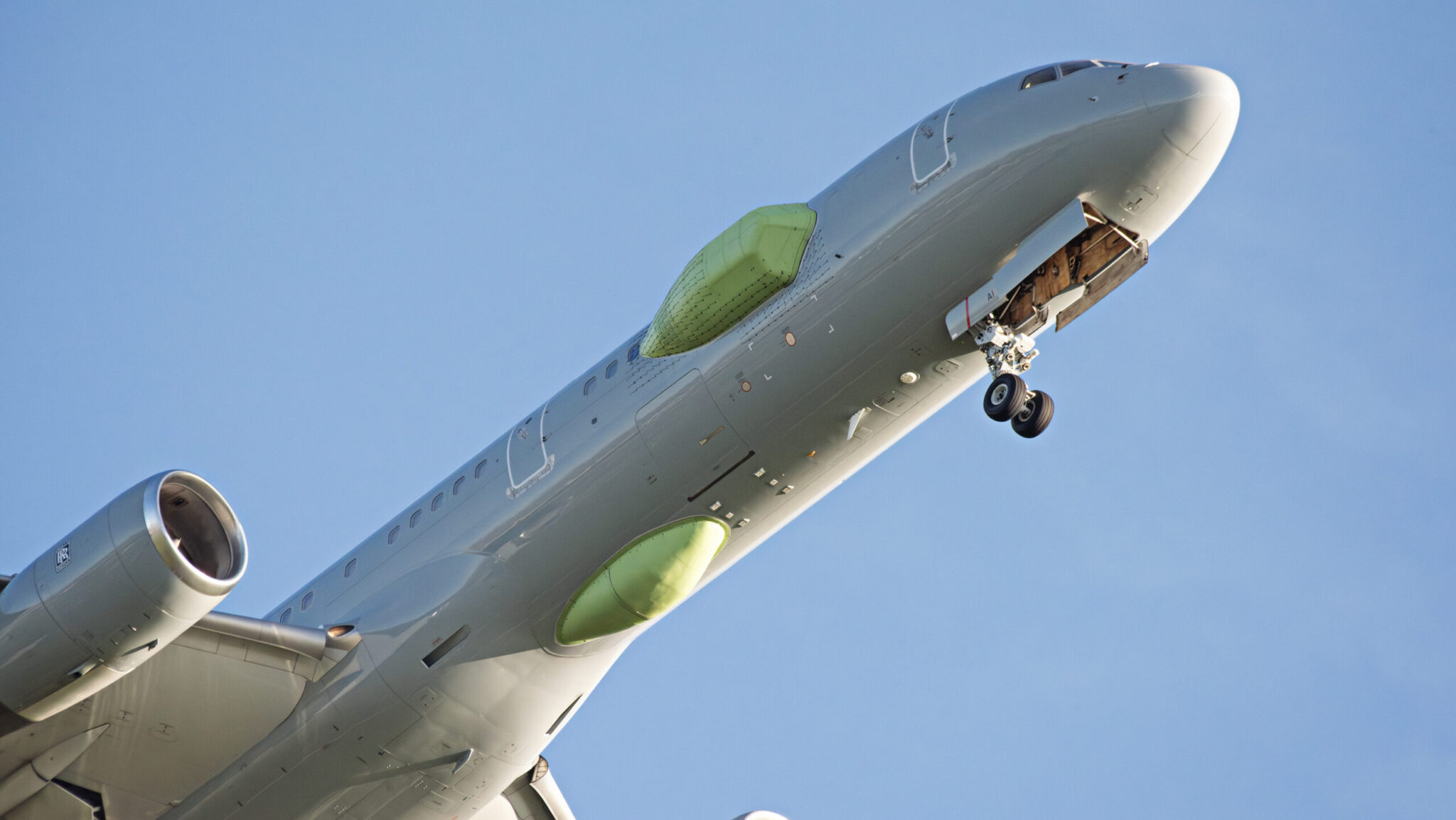
The development of the UK’s sixth-generation Tempest jet made a notable advancement this week, as the Ministry of Defence (MoD) and industry partners revealed the latest iteration of the Excalibur flight test aircraft (FTA) featuring integrated sensor pods.
At an event held on December 9 at a secure airfield in Wiltshire, representatives from Leonardo UK, 2Excel, and the MoD announced that Excalibur—a modified Boeing 757—successfully completed its first modification phase and initial flight testing. This includes the integration of side and belly pods designed to accommodate Integrated Sensors, Non-Kinetic Effects (ISANKE), and Integrated Communications Systems (ICS), key components for the Tempest program.
Excalibur conducted its inaugural flight with the new sensor pods on November 26, confirming airworthiness. Although these sensor pods are integral to the Tempest program, the aircraft is not expected to fly with operational ISANKE/ICS payloads until 2026.
“Further modifications will include a fighter jet-style nose cone to host advanced radar-based sensor demonstrators,” stated the MoD.
Excalibur serves as a “flying laboratory for combat air technology,” situated within the UK’s Future Combat Air System (FCAS) framework, which encompasses Tempest alongside other capabilities such as uncrewed aircraft, information systems, and weapon systems. Essentially, it is a platform for testing technologies envisioned for next-generation aircraft.
Currently, Excalibur is exclusively equipped with UK-developed technologies, confirmed Andrew Howard, Leonardo UK’s director for the Global Combat Air Program (GCAP). Despite Japan and Italy’s involvement in GCAP, he noted, “Everything you’ve seen so far is Team Tempest work initiated in 2018.” He added that as Team Tempest transitions to GCAP in the coming years, further collaboration with international partners is anticipated around 2027–2028.
Howard explained that Japan is utilizing a command and control (C2) aircraft to address its own ISANKE/ICS requirements within GCAP, which he described as similar yet distinct from the UK’s approach.
Looking ahead, Leonardo UK and 2Excel plan to integrate additional features into Excalibur by 2025, including the new Multi-Function Radar System (MRFS) and additional pods. A key part of this integration involves preparing the aircraft for a “three-point landing” to ensure the stability of the heavier nose and chin sections, with the next flight scheduled for March 2025.
In his closing remarks, Howard expressed enthusiasm over the scale of the sensor pods installed on Excalibur. He stated, “It really does bring it to life… the ambition of what we’re going to do with these complex sensors is really exciting. It’s another step on the journey.”
While acknowledging that the aircraft and sensors are still in development, he praised the progress made by 2Excel and the team, emphasizing the importance of building trust with their partners as they advance the Tempest program.