The United States is undergoing a strategic transformation of its maritime industrial base. Through a series of unprecedented initiatives, defense technology firms are aggressively expanding their production capabilities to address the critical needs of the Navy and the Marine Corps, marking a decisive moment in the architecture of maritime security.
Port Alpha: Saronic Redefines Vessel Manufacturing in Texas
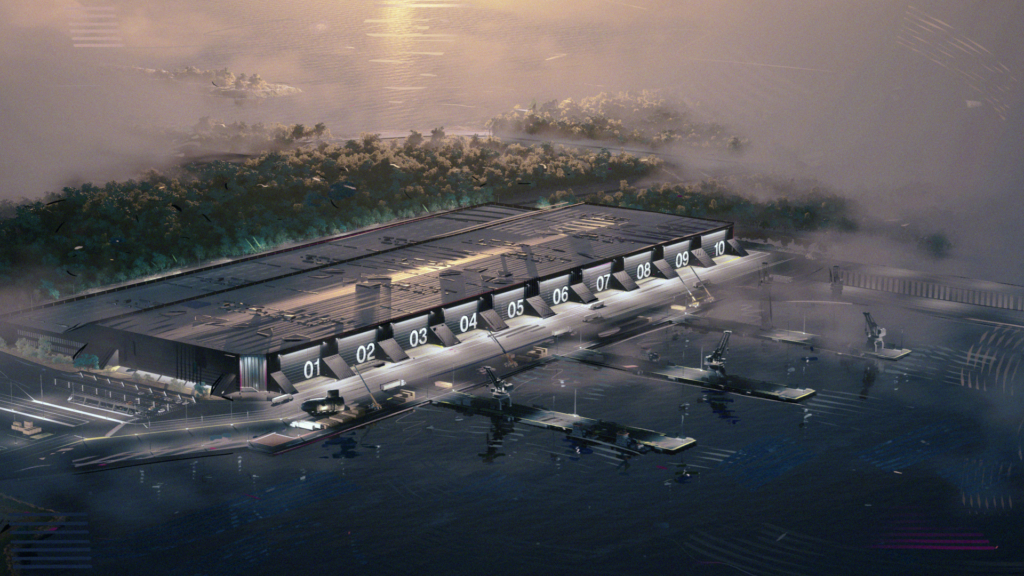
In Brownsville, Texas, construction has broken ground on „Port Alpha,” a shipyard designed from the ground up to meet modern, large-scale production demands. Spanning an initial 800 acres with the potential to expand to 4,000 acres, this ambitious project is set to become a major economic engine, with projections for 10,000 direct jobs in specialized fields such as robotics, software engineering, naval architecture, and precision machining.
The facility is architected to produce both autonomous and crewed vessels, with a focus on modularity and throughput efficiency. Among the first priorities are Landing Craft Utility (LCU) vessels, critical for transporting weapons and personnel, with deliveries expected by late 2028. This expansion complements existing operations in Louisiana, where autonomous surface platforms already utilized in international operations are currently manufactured.
Arsenal-2: Anduril Targets Submarine Production in Maryland
Simultaneously, on the East Coast at Tradepoint Atlantic in Baltimore County, Maryland, another pillar of the new maritime infrastructure is taking shape: „Arsenal-2.” Backed by a $6.6 billion total investment—including a significant influx of private capital—this complex will produce complex components and large-scale assemblies for Virginia-class submarines.
The project is designed to resolve supply chain bottlenecks that have hampered current submarine production rates. With over 3,000 direct and 11,000 indirect jobs projected, the new facility is scheduled to begin initial operations in 2030. The strategy calls for the initial production of basic modules, such as torpedo tubes, with capabilities evolving toward more complex vessel sections. In parallel, a secondary facility in California will accelerate the validation of production workflows, ensuring an operational head start for the success of Arsenal-2.
A Race Against Time for Maritime Sovereignty
These massive investments reflect an urgent necessity to accelerate the pace of shipbuilding. The sector is currently facing significant hurdles, including delayed material deliveries and a shortage of experienced labor. By increasing annual capacity and diversifying production sources, these new shipyards aim to stabilize the supply chain and ensure the fulfillment of strategic goals to deliver submarines and surface vessels at the pace demanded by national defense requirements.