As the global strategic landscape rapidly evolves, the United States Army is poised to redefine its command, control, and communications (C2) doctrine through the adoption of an ambitious concept: „hyperconnectivity.” This is not merely a term but a strategic vision for a ubiquitous network that will seamlessly integrate tactical line-of-sight radios, beyond-line-of-sight terminals, SATCOM, 5G, and Wi-Fi, ensuring an unbroken link across the battlefield of the future.
The central goal of this hyperconnected network is to equip Army divisions with the ability to transmit new and additional data to the tactical edge, using a variety of communications options, even in contested environments. With command echelons becoming more decentralized, C2 data sharing will also need to traverse greater distances and over the horizon, leveraging innovative waveforms.
A New Era of Warfare: The Imperative of Hyperconnectivity
Hyperconnectivity will increasingly come into play with the proliferation of autonomous systems on the battlefield and across all warfighting domains. Drones and robots, equipped with sensors, collect more data than ever before—information that must be transported in real-time to the appropriate commander. This instantaneous data sharing between sensors, shooters, and decision-makers will enable new operational concepts, such as the „kill web.”
„Hyperconnectivity is a technological approach to enabling modern warfare,” states Alain Cohen, president of Tactical Communications for Ultra I&C. He emphasizes that „modern warfare cannot rely on tactical communications of the past because they’re insufficient in terms of bandwidth, latency, and resiliency necessary to meet the demand of an autonomy-forward battlefield.” Whereas a single division may have had 15,000 or more warfighting nodes (made up of soldiers, vehicles, and C2 elements), thousands more nodes will now need to be added to account for the proliferation of autonomous systems, loitering munitions, and future human-machine teaming. This expansion is the largest driver in the development of next-generation tactical communications.
Weaving the Communications Web: Ultra I&C’s Integrated Solutions
The path forward for hyperconnectivity can be found in the emerging data transport layer market the U.S. Army is assessing: tactical radios with multiple line-of-sight waveforms for agility, troposcatter communications for a beyond-line-of-sight (BLOS) capability that can’t be jammed, and multi-orbit satellite terminals for global connections. Ultra I&C has all of these capabilities in its portfolio and is currently positioning them to play key roles in what the Army calls NGC2 – Next Generation Command and Control.
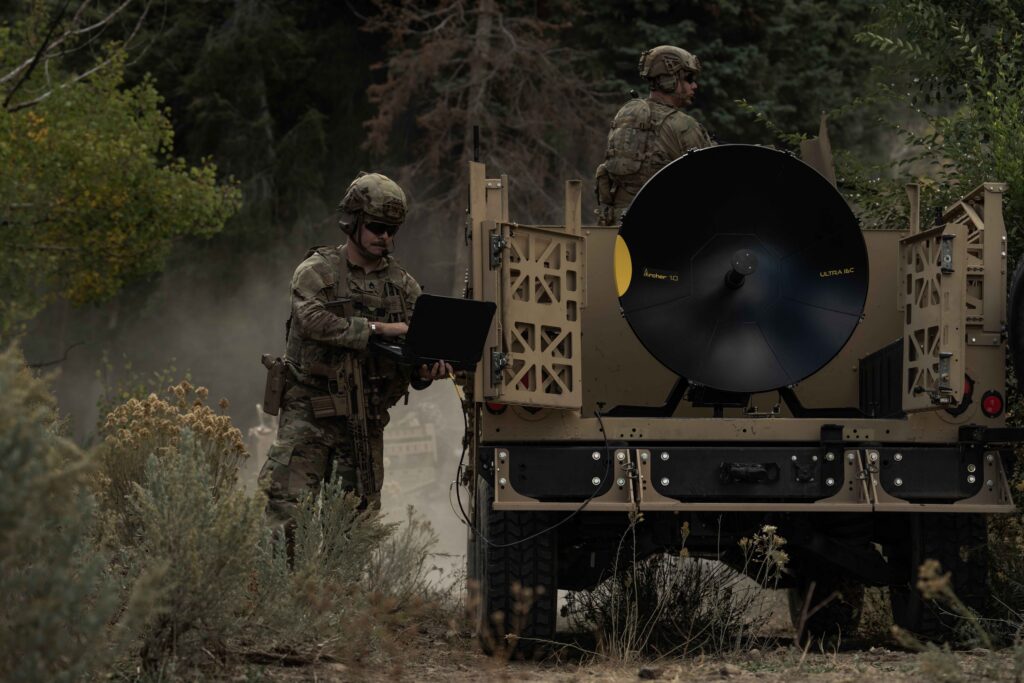
These include the next-generation software-defined radios in the Orion Gen 6 family of tactical radios, with multi-channel multi-waveform innovation for land, sea, and air missions. For BLOS comms, there’s the Archer family of expeditionary troposcatter communications systems that enable high-capacity long-range communication over the horizon without relying on satellites or ground-based infrastructure. Tropo, as it’s commonly called, provides resiliency by bouncing radio waves off the atmosphere to fill the gaps in SATCOM and line-of-sight relays being interfered with by electronic warfare.
In July, Ultra I&C demonstrated Orion radios and Archer troposcatter working in sync with European and NATO allies in Poland. To validate foundational data transport layer capabilities essential to modern warfare, where the speed of battlefield data determines operational success, Ultra I&C deployed the systems across five dispersed locations throughout Poland, delivering high-throughput data transmission across multiple waveforms and frequency bands.
The Heart of Connectivity: Waveform Innovation
Enabling, let alone accelerating, a completely new command architecture and doctrinal concept for C2 with the same waveforms designed a decade or longer ago is a non-starter. For the last six decades, Ultra I&C has been at the forefront of developing high-capacity waveforms for the US DoD and its coalition partners, consistently investing to ensure not only interoperability between generations of systems but also innovation between them.
This year marks the launch of the company’s latest high-capacity waveform, High Throughput Mesh (HTM), which lets users adaptively interconnect as the mission changes. Complementary with two waveforms currently in operation with the DoD for point-to-point and point-to-multipoint comms, HTM takes the best elements of both and builds on top to provide on-the-move C2 and fires applications. It boasts higher spectral efficiency and throughput rates than other Mobile Ad hoc Networking (MANET) waveforms in its class.
Clif Basnight, vice president of strategic technologies at Ultra I&C, emphasizes that „the reality is that it’s a hard road ahead for anybody who is still trying to build on waveforms that existed 5 to 10 years ago and expecting to get new levels of spectrum efficiency.” He adds, „We’ve learned every lesson we could by evaluating every published waveform and commercial communication innovation on the street to produce a waveform with high spectral efficiency that allows a network of our mesh radios to get after capacities greater than 200 megabits per second over various ranges to enable the standoff needed between a controller and a robot to increase survivability, for example. These are operational range-to-throughput performances that users haven’t been able to achieve to date, and now this gives them a real option to use outside of a test event.”
Waveform development must be continual because the threat continuously evolves. Orion radios and waveforms are designed to enable hyperconnectivity with features like frequency agility to move about a vast amount of spectrum without hardware changes, and multiple waveforms to provide the option of changing how data is transmitted based on mission and application needs.
The Integrated Portfolio: Building the Future of Military Communications
Hyperconnectivity is the ability to share data with others who are part of your mission, regardless of the transmission capabilities available: line of sight, beyond line of sight, mesh, point-to-point, point-to-multipoint, or a commercial waveform. This real-time data sharing between sensors, shooters, and commanders enables new operational concepts like the kill web, which requires more capable and agile tactical communication solutions.
Key barriers to enabling hyperconnectivity are the limited throughput, range, latency, and frequency agility of current tactical communications. Ultra I&C is developing new waveforms and hardware to address these gaps, providing orders of magnitude improvements in spectral efficiency and data rates.
Ultra I&C’s Orion radios, Archer troposcatter terminals, and Hunter flyaway SATCOM antennas feature multiple waveforms and capabilities to support different connectivity needs, from high-capacity line-of-sight links to non-line-of-sight tropospheric scatter and satellite communications. Ultra I&C has been rapidly developing and demonstrating these next-generation networking capabilities to support both urgent operational needs and long-term innovation necessary for next-generation command and control.