Breaking industrial links between Europe and the United States could take a decade to repair
A potential breakdown in industrial cooperation between Europe and the United States could leave European allies without critical military capabilities for as long as a decade, according to the head of one of Europe’s leading ammunition and rocket-motor manufacturers.
Morten Brandtzæg, chief executive of Norway’s Nammo, said the European and American defense industries had become so closely interconnected that dismantling shared production networks would immediately weaken the defense capabilities of both sides of the Atlantic.
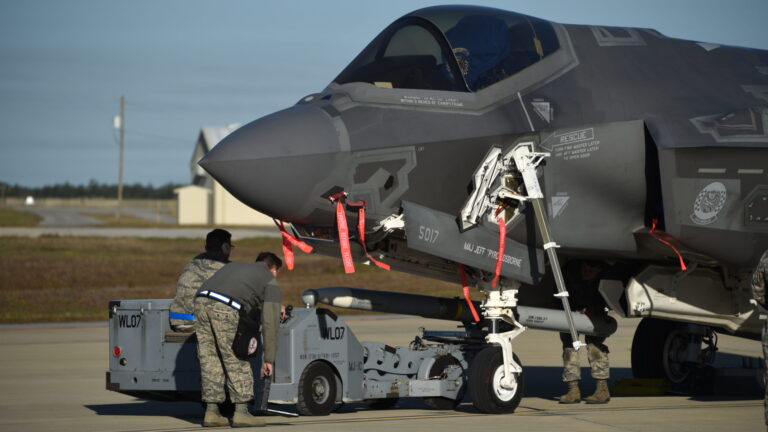
“If we can no longer deliver rocket motors for AMRAAM to Raytheon, none of Europe’s F-35s will have those weapons available,” Brandtzæg said at an event organized by the Norwegian company.
Norwegian-made motors support AMRAAM production
Raytheon, the U.S. manufacturer of the AMRAAM air-to-air missile, relies on rocket motors supplied by Nammo. These components are essential to the production and integration of missiles used by several air forces operating the F-35 fighter.
Brandtzæg said Europe would need between five and ten years to recreate an equivalent capability if its existing industrial links with the United States were severed.
“We do not have that much time,” he said, referring to the war in Ukraine and the worsening security environment in Europe.
In his view, the allied defense industrial base must be treated as an integrated system rather than as a collection of isolated national capabilities. Disrupting production flows and technology exchanges would rapidly weaken Western deterrence.
Political tensions are putting pressure on the transatlantic partnership
Relations between the United States and Europe have become increasingly strained during President Donald Trump’s second administration.
Washington has repeatedly pressed European allies to contribute more to their own defense. Trump has also threatened to take control of Greenland and, under certain circumstances, questioned the extent of the U.S. commitment to NATO’s Article 5 collective-defense principle.
European leaders have responded by calling for a stronger domestic defense industry and reduced dependence on the United States.
Nammo’s leadership argues, however, that short-term political turbulence must not destroy decades of industrial cooperation. Rather than dismantling shared supply chains, governments and companies should strengthen cooperation among NATO members and other close partners.
“Deterrence is built through cooperation among allied nations,” Brandtzæg said.
Nammo is ready to expand U.S. production
The Norwegian company says it is prepared to support a major expansion of rocket-motor production in the United States.
Nammo already operates a facility in Perry, Florida, and Brandtzæg said the company is considering additional investment to expand the site. The company is in ongoing discussions with U.S. authorities about increasing production of motors for missiles used by the U.S. government.
“We have the technology, and we have demonstrated that the process works. We are ready to increase production,” the executive said.
In Norway, the company recently established a third rocket-motor production line at its Raufoss complex. Its long-term plan calls for additional lines and a doubling of the facility’s size by 2032.
155-millimeter shell production remains inadequate
Nammo is also seeking to increase production of 155-millimeter artillery ammunition, which has been in extremely high demand since the beginning of the war in Ukraine.
The company is in a stronger position than it was last year, but production growth is still not sufficient to replenish European military stockpiles. In practice, almost everything being produced continues to be sent to Ukraine.
Nammo plans to open a new advanced manufacturing facility by the end of the year, with production expected to begin in 2027.
The project is valued at approximately $180 million. Construction is expected to take between two and three years, while the facility’s projected output would equal only about seven days of ammunition consumption in Ukraine.
The figures illustrate the scale of the ammunition shortfall facing Western allies and the difficulty of rebuilding strategic stockpiles quickly.
More orders will not solve the raw-material shortage
Increasing orders for artillery shells will not be enough unless the defense industry can also secure the raw materials needed to produce them.
Jack Watling, a military-science researcher at a British strategic studies institute, warned that if the war expanded into a direct conflict between Russia and NATO, the alliance’s most serious challenge would be maintaining the flow of ammunition from factories to the front line.
The problem extends beyond assembly capacity. Shell production depends on materials such as nitrocellulose and on reliable supplies of nitric acid, which is used in the manufacturing process.
Watling argued that Western governments should be cautious about approving additional 155-millimeter orders until industry demonstrates that it can increase production of these critical inputs.
Bureaucracy can make new industrial projects unprofitable
The construction of new propellant and explosives factories is also being slowed by infrastructure and regulatory obstacles.
In some countries, permitting and planning requirements can take so long and generate such high costs that an industrial project risks becoming unprofitable before production even begins.
According to Watling, simply placing additional orders will not resolve the crisis if there is not enough explosive material to fill the shells and if the required factories cannot be built within a reasonable timeframe.
Strengthening Europe’s defense industry will therefore require more than increased funding. It will also demand the removal of bureaucratic barriers, secure access to raw materials and the preservation of technological cooperation with the United States.