

Congressional funding is needed to launch production
Operational production of Anduril’s FQ-44 Fury drones for the U.S. Air Force’s Collaborative Combat Aircraft program cannot begin until Congress approves funding for fiscal year 2027.
Although the company has invested its own money in a new production facility and has started purchasing long-lead-time components, Anduril says it cannot move forward without federal procurement funding for the production contract.
Erin Simpson, Anduril’s vice president for strategy execution, said the company had already completed as much preparatory work as possible.
“We have invested and gone as far as we can. We will not have a cold start in 2027 — we will already have assets moving through production. That said, even a company like ours can only do so much without procurement dollars,” Simpson said.
First CCA production contracts were awarded in June
In June, the U.S. Air Force selected Anduril and General Atomics to build the first batch of Collaborative Combat Aircraft.
The drones are designed to operate alongside manned fighter jets, perform autonomous missions and expand the Air Force’s attack, surveillance and air-defense capabilities.
The exact number of aircraft covered by the production contracts has not been disclosed. Neither the Air Force nor the selected companies have specified how many aircraft will be built under the program’s first increment.
Continuing resolution keeps spending at fiscal 2026 levels
Earlier this month, Congress passed a continuing resolution to keep the government operating after the new fiscal year begins on October 1.
The measure maintains spending at fiscal 2026 levels through December 11 and restricts the Pentagon’s ability to launch new programs or expand contracts that do not yet have full-year appropriations.
If Congress fails to pass a budget in December and instead approves another temporary funding measure to allow additional time for negotiations, Anduril hopes the new resolution could include a funding exception.
Such an exception, known as an anomaly, would allow work to begin on the CCA production contract despite the broader spending freeze at previous-year levels.
The company says it is prepared to work with the Air Force to support such an arrangement.
“We are ready to turn dollars into airplanes, and we will do whatever we can to help make that happen,” Simpson said.
Air Force expects 500 CCA drones by 2032
Air Force Secretary Troy Meink said the service now expects to have approximately 500 CCA drones in service by 2032.
He did not specify how many of those aircraft would come from the program’s first increment or how many would be delivered through later development and production rounds.
The target reflects the Pentagon’s intention to rapidly field autonomous aircraft capable of complementing manned fighters and giving commanders additional options in high-intensity conflicts.
Arsenal-1 can produce up to 150 aircraft per year
Anduril’s Arsenal-1 facility near Columbus, Ohio, can produce up to 150 Fury aircraft annually, according to Jason Levin, the company’s senior vice president of engineering.
The Air Force’s current orders have not yet reached that level. However, the facility was designed to allow production to expand rapidly once funding is approved and orders increase.
While waiting for fiscal 2027 funding, Anduril is continuing to build Fury prototypes, designated YFQ-44, at Arsenal-1.
The company was the first of the two CCA contractors to deliver a prototype to the Air Force’s Experimental Operations Unit. That unit is developing the procedures and tactics needed to operate autonomous aircraft in the future.
YFQ-44 successfully fired an AMRAAM missile
In July, the Air Force announced that the YFQ-44 had become the first CCA aircraft to conduct a successful live-fire munition test.
The aircraft launched an AIM-120 AMRAAM air-to-air missile, demonstrating that the platform can employ weapons traditionally carried by manned fighters.
Following the test, Anduril began integrating additional weapons using its own funds. These include:
- 500-pound guided bombs;
- small-diameter bombs;
- low-cost cruise missiles, including the Barracuda 500;
- other air-to-air weapons;
- rocket pods;
- targeting pods.
The integration of these systems could allow the drone to conduct counter-unmanned-aircraft missions, intercept cruise missiles and carry out air-to-ground or air-to-surface strikes.
Testing is moving toward more complex operations
Anduril continues to support the Experimental Operations Unit during tests at Creech Air Force Base in Nevada.
The company says the exercises have progressed from basic demonstrations to increasingly complex operational scenarios. In one test, personnel conducted a rapid reload while the aircraft’s engine was still running.
Two operators replaced the YFQ-44’s AMRAAM without shutting down the engine. The procedure reduced the time between sorties from several hours to only a few minutes.
In other exercises, Air Force operators launched and recovered the aircraft without direct assistance from Anduril personnel. They flew the drone using its mission-autonomy software, demonstrating a higher level of operational independence.
Fury is being prepared to operate alongside manned fighters
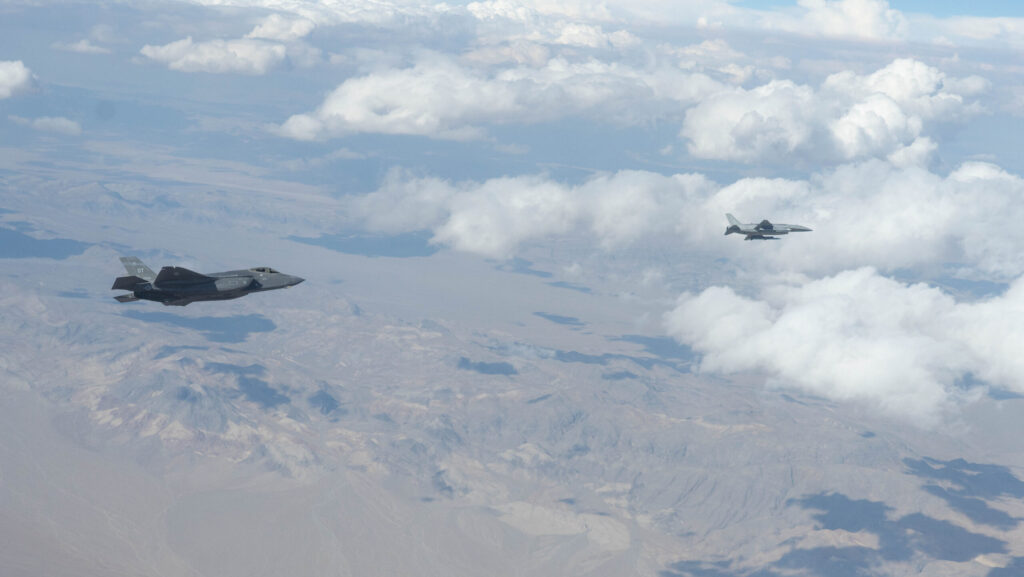
The YFQ-44 has flown in formation with F-35 aircraft. Anduril is also developing a more advanced capability known as “quarterback integration.”
Under this concept, a pilot flying a manned fighter would be able to control the drone remotely using a tablet or a similar interface.
The integration has already been tested in hardware-in-the-loop and software-in-the-loop environments, as well as directly on the aircraft.
The first full demonstrations in which a manned fighter controls a Fury aircraft are expected in the coming weeks or months.