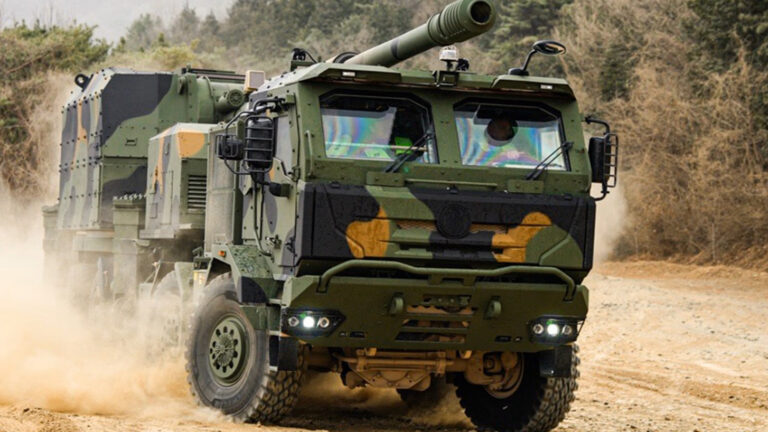
The US Army has awarded Hanwha Defense USA a contract to supply K9 self-propelled howitzer prototypes as part of its effort to modernize mobile artillery capabilities.
Six systems to undergo realistic operational testing
The agreement calls for the accelerated delivery of six MTC — Mobile Tactical Cannon — prototypes, with an option for 12 additional systems. The contract could ultimately be worth approximately $233 million.
US soldiers will employ the prototypes during a series of operational exercises designed to assess their technical performance, reliability and logistical supportability under conditions intended to replicate the demands of modern combat.
The data collected during the trials will help senior Army leaders determine how the system should be fielded in the future and whether it is ready to move toward broader procurement.
Major international defense companies competed for the contract
Hanwha Defense USA, the American subsidiary of South Korea’s Hanwha Aerospace, entered the competition with a wheeled version of its K9 artillery platform.
Several major defense manufacturers also competed for the program. Elbit America, working with Anduril and Oshkosh Defense, proposed the SIGMA system. Leonardo DRS, the US arm of Italy’s Leonardo, partnered with European land systems specialist KNDS to offer a Caesar howitzer variant.
Rheinmetall’s American subsidiary entered the competition with its remotely operated RCH 155 mm system. BAE Systems, through its US subsidiary, proposed the Archer artillery platform.
Hanwha expands its US industrial footprint
Hanwha Defense USA is establishing a facility in Opelika, Alabama, intended to support system integration and testing as the company seeks to strengthen its manufacturing presence in the United States.
The company has expanded its international reach in recent years, securing K9-related deals with countries including Finland, Romania, Norway and Poland.
Hanwha says that more than 2,500 K9 systems are already in service worldwide. The first prototype for the US Army is expected to be delivered in early fall, with the remaining five scheduled to arrive within less than a year.
Company representatives have also indicated that Hanwha does not intend to wait for the Army to define every requirement before preparing for production. The company plans to anticipate future needs and align its investments so that localization and domestic manufacturing activities can begin on or ahead of the Army’s preferred schedule.
New system intended to replace two artillery fleets
The modernization program is designed to replace both the towed M777 howitzers and the M109A7 self-propelled systems. Although the M109A7 incorporates substantial upgrades, the family is based on a design that first entered service in the 1960s.
The Army has made several previous attempts to develop a successor, but a number of those efforts ended without producing an operational replacement.
The XM2001 Crusader program was canceled in 2002. The Non-Line-of-Sight Cannon project was later abandoned as part of the broader restructuring of the Future Combat Systems initiative.
ERCA setbacks pushed the Army toward existing solutions
The most recent major effort was the Extended Range Cannon Artillery program, or ERCA. The project sought to mount a 58-caliber gun, approximately 30 feet long, on the M109A7 Paladin chassis.
The weapon was intended to fire 155 mm rounds to ranges of up to 70 kilometers. In 2024, however, the Army halted development after live-fire testing exposed serious technical difficulties, including excessive wear on the cannon and related components.
Rather than continue developing an entirely new howitzer or extensively modifying an existing platform, the Army turned to systems already available or nearing production. The evaluation process included an international demonstration campaign before moving to a formal competition among established manufacturers.
Although the program was delayed by several months to better align with the Army Transformation Initiative, the decision was reached only 11 months after the Army issued a request for information to industry in September of the previous year.
Promotional content
Capable, affordable munitions for modern threats
L3Harris’ launched-effects portfolio draws on proven capabilities and decades of experience in developing effective and affordable munitions for the demands of contemporary warfare.