A new unmanned aircraft for long-endurance surveillance and strike missions
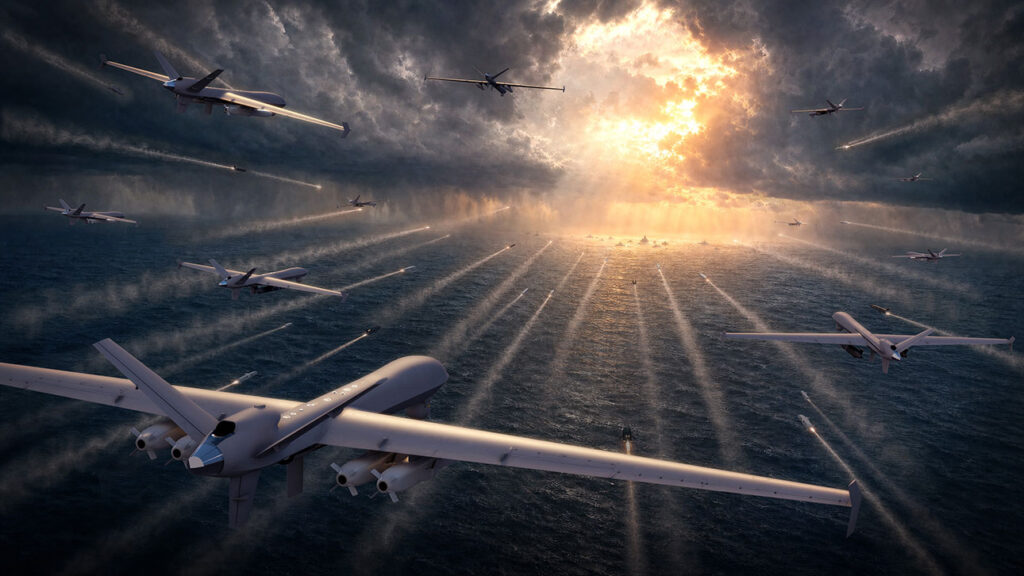
General Atomics Aeronautical Systems has formally unveiled Wildfire, a clean-sheet unmanned aircraft designed to replace the company’s MQ-9A Reaper.
The manufacturer claims that the new drone can be produced rapidly and is capable of exceeding the performance and cost targets established by the US Department of Defense for its next-generation aircraft.
Wildfire is intended to perform missions traditionally assigned to the Reaper, including long-endurance intelligence, surveillance and reconnaissance operations as well as precision strikes. General Atomics is also promoting the aircraft for civilian applications outside wartime, including the transport of commercial cargo.
Greater payload capacity and expanded mission options
According to General Atomics, Wildfire offers a larger payload capacity than the Reaper and features reinforced hardpoints. These characteristics could allow the aircraft to perform a broader range of missions, including the movement of commercial freight.
GA-ASI President David Alexander described Wildfire as an aircraft designed for demanding missions and cost-conscious customers. He said the platform combines the high capability associated with the company’s aircraft with flexibility, scalability and tolerance for attrition.
Wildfire enters the competition for the Massed Modular Aircraft program
General Atomics is offering Wildfire for the Massed Modular Aircraft program, launched in July by the US Air Force and the Defense Innovation Unit to identify a successor to the MQ-9A Reaper.
Lt. Gen. Christopher Niemi, the Air Force’s chief modernization officer, recently said the program had been accelerated after what he described as concerning Reaper losses during combat operations against Iran.
The Pentagon is seeking a cheaper platform that can be used in high-risk operations without imposing the financial burden associated with more expensive and sophisticated aircraft.
Pentagon targets a unit cost of about $10 million
Depending on its configuration, an MQ-9 Reaper can cost as much as $50 million. Production of the aircraft ended last year, although the upgraded MQ-9B SkyGuardian remains in production.
The Pentagon is targeting a unit cost of approximately $10 million for the Massed Modular Aircraft, excluding mission equipment.
The program’s industry solicitation calls for the future aircraft to self-deploy over a distance of 8,000 nautical miles and carry a payload of at least 2,800 pounds.
General Atomics says Wildfire meets or exceeds all of those requirements. The company claims the aircraft offers more than 8,000 nautical miles of ferry range and can carry two long-range anti-ship missiles simultaneously.
A platform built for weapons, sensors and autonomous operations
According to the manufacturer, Wildfire can carry different combinations of munitions, launched effects, sensors and other mission payloads.
The aircraft was designed from the outset to operate with a high degree of autonomy and to conduct collaborative missions with other platforms. That architecture could allow Wildfire to operate as part of distributed combat networks involving both unmanned and crewed aircraft.
General Atomics promises deliveries ahead of 2031
The Pentagon’s initial plan called for the Massed Modular Aircraft system to become operational by fiscal year 2031, with at least 20 mission-ready drones.
General Atomics says Wildfire could be delivered several years earlier than that deadline. The company also claims it could produce more than twice as many aircraft during the same period.
The program could mirror the Air Force’s autonomous wingman initiative
US officials expect the Massed Modular Aircraft effort to follow an approach similar to the Collaborative Combat Aircraft program, which focuses on developing unmanned wingmen capable of operating alongside crewed aircraft.
That model relies on open architectures and successive design increments, allowing new capabilities to be introduced gradually over time.
Niemi indicated that the future aircraft would not necessarily feature cutting-edge technology. He suggested that it would probably use a turboprop engine and a high-aspect-ratio wing — design choices intended to reduce cost while maximizing endurance.