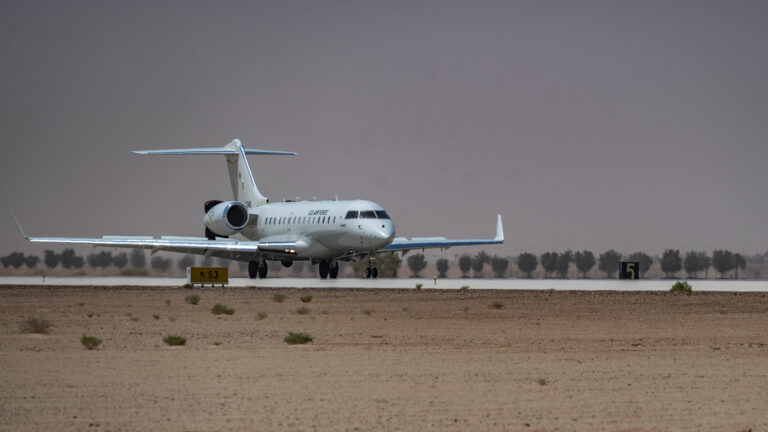
In a strategic pivot signaling the transition to a more digitized and satellite-dependent era of warfare, the U.S. Air Force has revealed plans to retire its fleet of E-11 Battlefield Airborne Communication Node (BACN) aircraft by fiscal year 2028. The move underscores a fundamental shift in defense priorities, moving away from dedicated relay aircraft toward integrated, multi-platform satellite connectivity.
Retiring the Relay: The End of the BACN Era
The E-11 aircraft—a modified Bombardier Global business jet tasked with serving as a high-altitude data bridge—has been a cornerstone of battlefield connectivity since 2005. Often referred to as „Wi-Fi in the sky,” the BACN platform allowed disparate military systems to communicate across rugged terrain. However, military leadership has now confirmed that the current fleet of seven aircraft will be replaced by the emerging Department of the Air Force (DAF) Battle Network.
Budgetary documents for FY27 show a complete zeroing out of funds for the E-11 program, which has seen nearly $300 million in investment since its inception. The divestment reflects a strategic calculation that the contested electromagnetic environments of tomorrow require more than just a modified commercial jet; they require a decentralized and resilient web of communication.
The Hybrid Bridge: Satellite Terminals Take Flight
As the Air Force prepares to phase out the E-11, a „near-term bridge” has been identified in the form of the Hybrid SATCOM Terminal program. Instead of relying on a single dedicated relay aircraft, this initiative will integrate advanced satellite communication terminals across a wide array of existing platforms, including KC-135 Stratotankers and B-1 Lancer bombers.
These hybrid terminals are designed to access both military and commercial satellite constellations across multiple orbital regimes. This redundancy is critical for maintaining secure communications in the face of sophisticated jamming efforts. Experimental flight tests are slated to continue through 2028 across nine different aircraft types, ensuring that the transition to the DAF Battle Network does not leave a capability gap in the interim.
Realigning the Arsenal: Progress on Wedgetail and Compass Call
The sunset of the E-11 program coincides with significant updates to other key aerial platforms. The E-7 Wedgetail program, which narrowly escaped budget cuts last year following congressional intervention, is now expanding. Official testimony confirms that five additional developmental aircraft have been put on contract, bolstering the two rapid prototypes already in progress.
Furthermore, the Air Force is significantly increasing its commitment to electronic warfare. While previous budget documents suggested a modest fleet of 12 EC-138 Compass Call aircraft, new strategic plans call for a total of 22 units. This expansion signals a heightened focus on electronic attack capabilities, ensuring that as the Air Force modernizes its communication networks, it also retains the power to disrupt those of its adversaries.